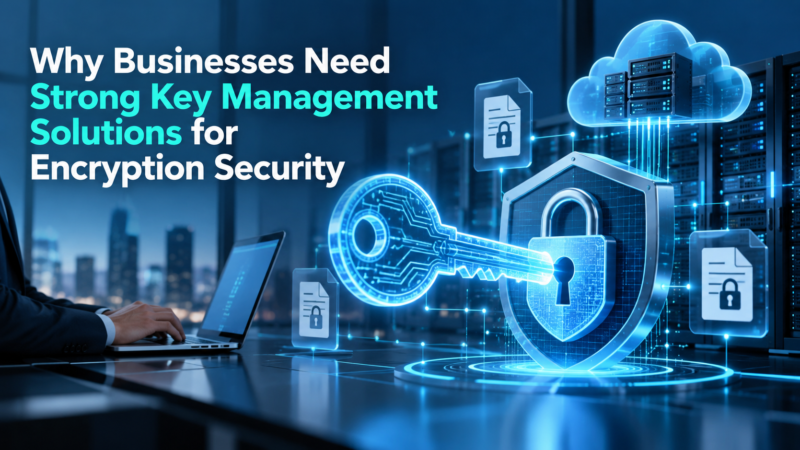
Thales Key Management: Understanding Its Role in Enterprise Encryption

Introduction
Enterprise organizations increasingly rely on encryption to protect sensitive information. Businesses encrypt databases, cloud storage, application data, backups, communications, and confidential documents.
Encryption provides important protection, but it depends on cryptographic keys.
These keys control encryption and decryption operations. They can also support digital signatures, authentication, certificates, and secure communications.
As organizations expand their infrastructure, managing cryptographic keys can become complicated.
Businesses may operate multiple cloud environments, on-premises data centers, applications, databases, and digital services. Each environment may require different cryptographic keys.
This makes centralized Key management increasingly important.
Thales key management can support enterprises that need centralized capabilities for managing encryption keys across distributed environments.
Understanding Enterprise Encryption
Encryption converts readable information into an encrypted form using a cryptographic algorithm and key.
Authorized systems can use the appropriate key to perform the required cryptographic operation.
Organizations commonly use encryption to protect:
- Customer data
- Financial information
- Employee records
- Database information
- Cloud storage
- Application data
- Backup information
Encryption can protect information from unauthorized access, but the organization must also protect the associated cryptographic keys.
Why Key Management Matters
An encryption key can provide access to protected information.
If an attacker obtains a critical key, the security of the information associated with that key may become compromised.
Organizations therefore need strong processes for controlling keys.
Key management includes:
- Generation
- Storage
- Distribution
- Access
- Usage
- Rotation
- Backup
- Recovery
- Retirement
- Destruction
Key Management in Cryptography
Key management in cryptography provides the framework for controlling cryptographic keys throughout their lifecycle.
A mature approach allows organizations to answer important questions:
- What keys exist?
- What information do they protect?
- Who owns them?
- Which applications use them?
- Who can access them?
- When should they rotate?
- When should they retire?
These questions become increasingly important as enterprises grow.
The Challenge of Distributed Encryption
Enterprise infrastructure is rarely located in one place.
Organizations may use:
- On-premises servers
- Public cloud platforms
- Private clouds
- Hybrid infrastructure
- SaaS applications
- Multiple databases
Cryptographic keys may exist across all these environments.
Managing keys independently can result in fragmented policies and limited visibility.
Centralized Key management can help address this challenge.
The Role of Thales Key Management
Thales key management can provide centralized capabilities for managing cryptographic keys across enterprise environments.
Centralized management can help organizations maintain information about:
- Key ownership
- Key status
- Key usage
- Access permissions
- Rotation schedules
- Lifecycle activities
This can help security teams establish more consistent policies.
Improving Key Visibility
Visibility represents an important component of enterprise encryption security.
Organizations should know where critical cryptographic keys reside and which systems depend on them.
Centralized Key management can provide a structured view of cryptographic assets.
This can help security teams identify:
- Active keys
- Expired keys
- Keys approaching rotation
- Unused keys
- Keys associated with retired applications
Managing Key Ownership
Organizations should assign clear ownership to important cryptographic keys.
The owner should understand the key’s:
- Purpose
- Associated application
- Protected information
- Access requirements
- Rotation schedule
- Retirement requirements
Clear ownership supports accountability.
Protecting Encryption Keys
Organizations should protect encryption keys using appropriate security mechanisms.
They should avoid storing critical keys in application source code or easily accessible configuration files.
For high-value cryptographic assets, businesses may use dedicated hardware security technologies.
These technologies can provide additional protection while supporting cryptographic operations.
Key Rotation
Organizations should establish key rotation policies.
Rotation replaces an existing key with a new cryptographic key.
The process should consider application dependencies and operational requirements.
Security teams should test rotation procedures before applying them to critical systems.
Key Backup and Recovery
Businesses should maintain secure backup procedures for critical cryptographic keys.
Key recovery becomes especially important when encrypted information must remain available during system failures or disaster recovery events.
Organizations should regularly test recovery procedures to verify that authorized teams can restore access when necessary.
Cloud Encryption
Cloud environments create new requirements for enterprise encryption.
Organizations may encrypt cloud databases, object storage, virtual machines, applications, and backups.
These environments may also interact with on-premises systems.
Centralized Key management can help organizations establish consistent policies across cloud and traditional infrastructure.
Database Encryption
Many enterprises use encryption to protect sensitive databases.
A database may contain:
- Customer records
- Financial information
- Personal information
- Employee data
- Transaction histories
Encryption protects this information, while Key management protects the associated cryptographic keys.
A strong architecture should separate encrypted data from its keys wherever appropriate.
Monitoring Key Activity
Organizations should monitor cryptographic activity to maintain visibility.
Important events can include:
- Key creation
- Key access
- Key rotation
- Administrative changes
- Failed access attempts
- Key retirement
Monitoring can help security teams identify unusual activity.
Supporting Enterprise Security Policies
Organizations should define clear Key management policies.
Policies should address:
- Key generation
- Key storage
- Access
- Rotation
- Backup
- Recovery
- Retirement
- Monitoring
These policies should integrate with the organization’s broader cybersecurity program.
Benefits of Centralized Key Management
Greater Visibility
Security teams can maintain a more complete view of cryptographic assets.
Consistent Policies
Organizations can apply common rules across different environments.
Better Lifecycle Management
Security teams can coordinate key rotation, recovery, and retirement.
Improved Access Control
Organizations can restrict cryptographic access based on defined requirements.
Better Governance
Centralized records can support internal security reviews.
Best Practices
Businesses should:
- Maintain a complete key inventory
- Assign ownership
- Apply least-privilege access
- Separate keys from protected data
- Automate appropriate lifecycle processes
- Monitor key activity
- Protect critical keys using appropriate technologies
- Test recovery procedures
- Retire obsolete keys
- Review Key management policies regularly
Conclusion
Enterprise encryption protects sensitive information across applications, databases, cloud infrastructure, and business systems.
However, encryption security depends heavily on the protection and management of cryptographic keys.
Thales key management can support centralized administration of cryptographic keys across distributed enterprise environments.
Key management in cryptography provides the lifecycle framework required to generate, store, access, rotate, recover, and retire keys.
Effective Key management helps organizations maintain visibility, establish consistent policies, restrict access, and manage cryptographic assets more systematically.
By integrating centralized key management with encryption, access controls, monitoring, and secure lifecycle practices, enterprises can establish stronger control over their encryption infrastructure.