A Complete Guide to Mass Units and Their Conversions
The Recipe That Weighed Too Much
Sana was an exchange student who loved baking. One Saturday, she found her grandmother’s cookbook, which called for “8 ounces of butter and 2 pounds of flour.” Her kitchen scale showed only grams and kilograms.
She guessed, and the cake came out like a brick.
“Units matter,” her physics teacher said when she told the story. “Sometimes more than you’d think.”
This guide walks you through the units we use for mass, how to convert between them, and why getting it wrong can cost real money, and even lives.
First, What Are We Measuring?
A Quick Refresher
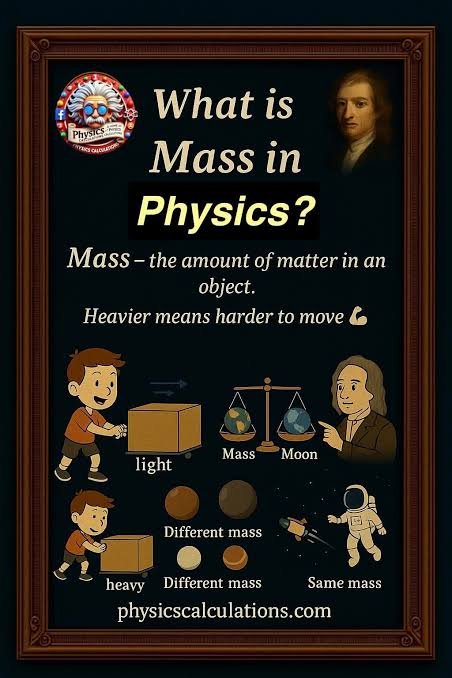
Mass is the amount of matter in an object, and it stays the same wherever you take it. If you want a fuller explanation, this overview of mass definition physics covers the concept in depth. For our purposes, remember this: units are just agreed-upon yardsticks for mass, and converting between them is only multiplication or division.
The SI Base Unit
The official SI unit of mass is the kilogram (kg). It is the only SI base unit with a prefix built into its name. Since 2019, it has been defined using the Planck constant rather than a physical metal cylinder. Every other metric mass unit is built from it.
The Metric Family: Easy by Design
Ladder of Tens
Metric units are friendly because they move in powers of ten:
- 1 kilogram = 1,000 grams
- 1 gram = 1,000 milligrams
- 1 milligram = 1,000 micrograms
- 1 metric tonne = 1,000 kilograms
To convert, you just move the decimal point. Sana’s 2 kilograms of flour is 2,000 grams. No tricky arithmetic needed.
Where Each Unit Shines
Tonnes handle cargo and crops. Kilograms handle people and groceries. Grams handle recipes and nutrition labels. Milligrams handle medicine, where a typical paracetamol tablet contains 500 mg. Micrograms handle vitamins and trace elements.
The Imperial and US Customary Maze
Pounds, Ounces, and Stones
Sana’s grandmother used the imperial system, and its units are not decimal. Here are the key relationships:
- 1 pound (lb) = 0.45359237 kg (exactly, by international agreement since 1959)
- 1 pound = 16 ounces
- 1 ounce ≈ 28.35 grams
- 1 stone = 14 pounds ≈ 6.35 kg
So Sana’s 8 ounces of butter is about 227 grams, and her 2 pounds of flour is about 907 grams. When she redid the recipe with those numbers, the cake rose beautifully.
The Three Kinds of Ton
This one trips up even adults. There are three different “tons”:
- Metric tonne: 1,000 kg
- US short ton: about 907 kg
- UK long ton: about 1,016 kg
A difference of roughly 110 kg between the short and long ton can matter enormously in shipping contracts.
Who Still Uses What?
The metric system is the global standard. Only a handful of countries, most often cited as the United States, Liberia, and Myanmar, have not officially adopted it for everyday use. That means students and professionals regularly work across both systems.
Specialty Units With Their Own Stories
Carats and Troy Ounces
Jewelers measure gemstones in carats, where one carat equals exactly 200 milligrams. The famous Hope Diamond weighs about 45.52 carats, which is only around 9 grams.
Precious metals use the troy ounce, equal to about 31.1 grams. It’s slightly heavier than the standard ounce, so a troy ounce of gold outweighs an ordinary ounce of flour.
The Atomic Mass Unit
At the tiniest scale, scientists use the atomic mass unit (u), equal to about 1.66054 × 10⁻²⁷ kg. A single hydrogen atom has a mass of roughly 1 u. Chemists love it because it makes atomic numbers manageable.
The Cheat Sheet: Conversions You’ll Actually Use
Simple Multipliers
- kg to lb: multiply by about 2.2046
- lb to kg: multiply by about 0.4536
- g to oz: divide by about 28.35
- oz to g: multiply by about 28.35
- tonnes to kg: multiply by 1,000
A Worked Example
Say a package weighs 12 pounds. To convert to kilograms: 12 × 0.4536 = 5.44 kg. To check yourself, remember that a kilogram is more than two pounds, so the kilogram number must be smaller than the pound number. If your answer comes out larger, you’ve flipped the operation.
When Conversions Go Wrong
The Gimli Glider
In 1983, Air Canada Flight 143 was fueled using pounds when the calculation required kilograms. Because a kilogram is more than twice a pound, the plane took on less than half the fuel it needed. Midway through the flight, both engines failed. The pilots glided the Boeing 767 to an emergency landing at Gimli, Manitoba, and all 69 people aboard survived.
The Mars Climate Orbiter
In 1999, NASA lost its $125 million Mars Climate Orbiter. One team’s software produced thrust data in pound-force seconds, while another expected newton-seconds. One pound-force is about 4.45 newtons, and that mismatch sent the spacecraft too close to Mars, where it was destroyed.
These weren’t failures of intelligence. They were failures of units, which is exactly why careful labeling and double-checking are habits worth building early.
Sana’s Final Lesson
A month later, Sana’s class took a quiz. One question asked her to convert 3.5 kilograms to pounds.
She smiled, remembering her brick of a cake. She multiplied 3.5 by 2.2046 and wrote 7.72 lb. Then she sanity-checked it: the pound number was bigger than the kilogram number, as it should be.
“Perfect,” her teacher wrote in the margin.
Key Takeaways
- The kilogram is the SI base unit of mass, defined since 2019 by the Planck constant.
- Metric conversions move in powers of ten, which makes them easy.
- 1 lb = 0.45359237 kg, and 1 oz ≈ 28.35 g.
- Beware the three different tons: metric, short, and long.
- Specialty units like carats, troy ounces, and atomic mass units serve specific fields.
- Always label your units and run a quick sanity check, since conversion errors have grounded airliners and sunk spacecraft.
Next time a recipe, a lab problem, or a shipping label throws unfamiliar units your way, take a breath and convert step by step. You’ll get it right.