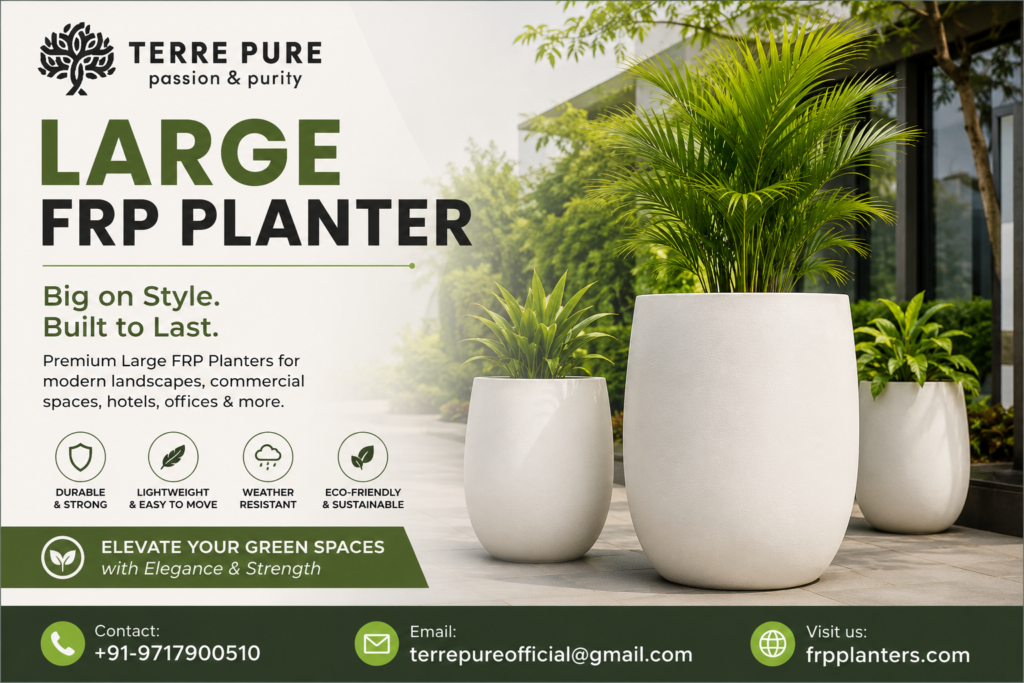
An area landscape architect in another region has told us that he/ she no longer recommends cement planters (for roof projects) because of the weight for the slab load calculations, and/because of the delay in time to get the size he/she needs. Our large FRP planters have solved that. No one wants to be the bringer of the bad news. Your planters have arrived broken, or worse, the structural engineer has brought up a weight load concern after the fact. Fiberglass Reinforced Plastic2 (FRP2 solves that, and does it without the six week lead time of stone fabrications and cements.
So any commercial purchaser would almost certainly be considering three things simultaneously appearance, durability and an already given project time frame that they have had little influence over. A commercial or high end residential gardener will see a large scale planter as bulky but not too heavy on the design or finances this is where in commercial landscape or high end residential the use of FRP will pay dividends…
Specification: What “Large” Actually Means in FRP Manufacturing
Size alone doesn’t tell you much. Two planters can both be labeled “large” and behave completely differently under load, weather, and years of soil compaction.
Standard Dimension Ranges
Large FRP planters typically run from 90 cm to over 200 cm in diameter or length, with heights matched to proportion — usually 60 cm to 150 cm. Custom fabrication goes well beyond that for statement pieces in hotel lobbies or corporate atriums.
Wall Thickness and Lamination Layers
This is the detail most buyers skip entirely — they ask about size and finish, almost never about lamination. A planter’s durability comes down to how many layers of fiberglass mat are laid into the resin, not just the resin grade. Thin lamination on a large planter means it’ll flex, and flexing over time cracks the gel coat.
Finish Options
Matte, textured stone-effect, metallic, and custom RAL color coating are standard. UV-stabilized gel coat is not optional for outdoor use — we’ll get to why in a minute.
Objective: Five Criteria for Evaluating Any FRP Planter Supplier
Here’s how to actually vet a supplier instead of trusting a catalog PDF.
- Lamination transparency. A good supplier tells you the number of fiberglass layers and resin type unprompted. A bad answer is “premium quality material” with no specifics — that phrase means nothing on a spec sheet.
- UV and weathering data. Ask what accelerated weathering testing was done, if any. A bad answer dodges the question or claims “it won’t fade” with no basis.
- Load and drainage design. Large planters need engineered drainage, not just drilled holes. A bad answer is “we can drill holes wherever you want” — that’s not drainage design, that’s improvisation.
- Defect and breakage policy in writing. A supplier who says “we’ll handle defects case by case” doesn’t have a policy. That’s a negotiation you’ll lose after the shipment lands.
- Actual lead time with buffer. Ask for the honest number, not the marketing number. A bad answer is a lead time with no mention of curing time, which is non-negotiable in FRP fabrication.
Benefits: Why Large FRP Planters Protect Both Budget and Margin
- Weight savings cut structural cost. FRP planters weigh a fraction of stone or concrete equivalents, which matters directly on rooftop and podium-level installations where load capacity is fixed.
- Lower freight cost per unit. Because the material is light, shipping large-format planters — even internationally — costs less than moving the same footprint in concrete.
- Longer service life reduces replacement cycles. A properly laminated FRP planter with UV-stable coating holds its finish for years outdoors, which means fewer callbacks and fewer unhappy end clients.
- Mold reuse lowers per-unit cost at volume. Once a mold is built, repeat orders in the same size come down significantly in per-unit price — something bulk buyers should always ask about.
- Design flexibility protects specification intent. Custom colors and finishes mean the designer’s original vision survives procurement, instead of getting substituted for “closest available.”
- Corrosion and rot resistance removes a maintenance line item. Unlike metal planters, FRP doesn’t rust, and unlike wood, it doesn’t rot at the base where moisture sits longest.
Availability: Sourcing Large FRP Planters Across India
Location isn’t just an address on an invoice. It’s a supply chain decision. Buyers searching for Large FRP Planter Manufacturers in India are usually trying to solve for two things at once — reliable quality control and freight cost that doesn’t eat the project margin.
Manufacturing hubs in Gujarat and Maharashtra dominate India’s FRP production because of proximity to resin and fiberglass raw material suppliers, which shortens the input pipeline considerably. That’s a real advantage over buyers importing from suppliers with thinner domestic material access. Working with established Large FRP Planter Suppliers in India also means shorter transit for pan-India delivery — a project in Bengaluru or Pune isn’t waiting on a container from overseas.
One thing that catches buyers off guard: large planters shipped across states still need reinforced crating, and that adds cost most quotations don’t itemize upfront. Ask for it separately.
About Us
We’ve been fabricating FRP products since 2013, and planters have been core to that work for most of it. We stopped using a particular polyester resin blend in 2021 after three commercial clients flagged premature yellowing in high-UV coastal installations. We switched suppliers for that resin component and haven’t had the complaint since. That’s the kind of correction you only make when you’re actually accountable to the people using your product outdoors, year-round.
We manufacture, we don’t just assemble from bought-in shells. Every large planter that leaves our facility has gone through the same lamination checks, regardless of whether it’s a one-off custom order or a bulk hospitality contract.
CTA
If you’re evaluating a Large FRP Planter for a project, send us your dimensions, quantity, and intended location — indoor, outdoor, or coastal — and we’ll get back to you within 24 hours with a lead time and quote. Minimum order quantity for standard sizes starts at 10 units; custom molds are quoted separately. Reach out to FRP Planters directly through frpplanters.com and we’ll walk you through lamination specs before you commit to anything.
Conclusion
A large planter is to be seen as a systems choice, not design choice. Treat it as such at the early design stage and you have avoided re-doing the work. Whatever order you are placing with Large FRP Planter Manufacturers for a one-time only roof garden installation or setting up an ongoing supply chain for a hotel chain, details such as lamination, drainage and UV coating are more important than the catalog shot. FRP landscape products in India are a very competitive market,-those asking the hard questions beforehand will not have to re-order in six months time.
FAQs
So to get an idea of how much heavier a normal size FRP planter is compared to a concrete one:
Depending on wall thickness but predominantly for the same footprint FRP approximately one fifth to one third of concrete weight. This is ultimately the figure required to convince structural engineers approving roof projects.
Can large FRP planters handle outdoor installation in coastal or high-UV areas?
Yes, but only with a UV-stabilized gel coat — and honestly, not every supplier applies one correctly. If a quote doesn’t mention UV stabilization separately, ask before you order.
Do Large FRP Planter Suppliers in India offer custom sizes beyond standard catalog listings?
Most established manufacturers do, since molds can be built to custom dimensions. The tradeoff is lead time — custom molds add production time upfront that repeat standard orders don’t have.
How long does a large FRP planter typically last outdoors?
With proper lamination and UV coating, well beyond a decade in most climates. We won’t claim a specific number without knowing your exact environment — coastal salt exposure and high-altitude UV both shorten that window.
What’s the minimum order quantity for large FRP planters?
It varies by supplier, but standard-size bulk orders usually start around 10 units. Custom one-off pieces are often quoted individually without an MOQ.