Traditional Search vs. AI Search: What Users Need to Know
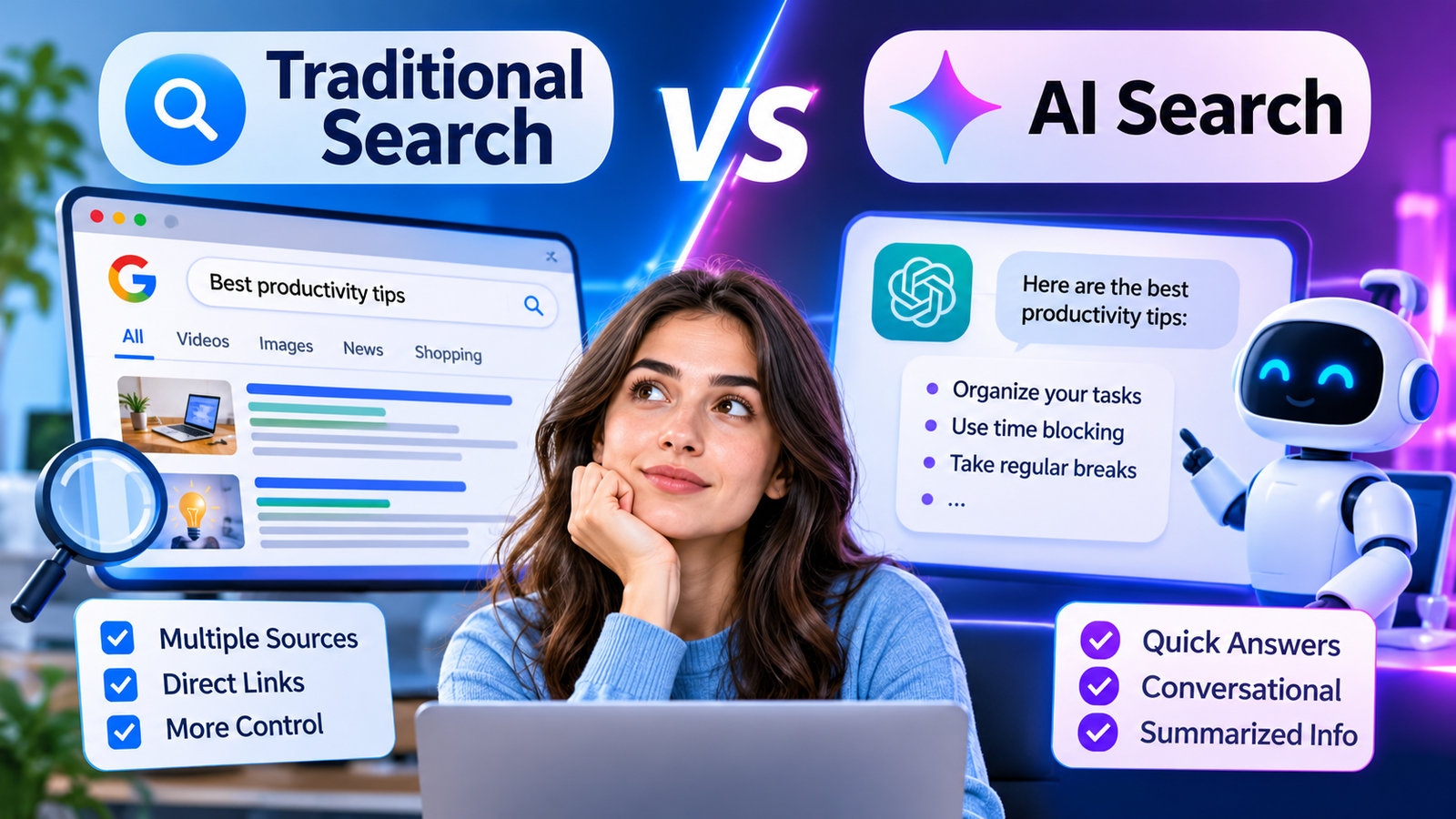
The way people find information online is changing rapidly. For many years, traditional search engines have helped users discover websites, articles, videos, and other online resources through keyword-based searches. Today, artificial intelligence is introducing a different approach by providing conversational answers, summarizing information, and understanding questions in a more natural way.
Both traditional and AI-powered search have advantages, but they also work differently. Understanding these differences can help users choose the right search method, evaluate information more effectively, and maintain greater control over their online experience.
As AI-powered features become increasingly integrated into search engines, some users may also want to customize what they see. For example, people who prefer conventional search results can explore this guide on how to turn off Google AI features to better understand the available settings and options.
1. How Traditional Search Works
Traditional search engines rely on complex algorithms to discover, index, and rank web pages. When someone enters a query, the search engine examines its index and displays pages that are considered relevant to the search terms.
These results typically include website links, page titles, descriptions, images, videos, and other search features.
For example, searching for information about improving website security may produce articles from technology websites, official documentation, product pages, and discussion forums.
Users can open different sources, compare their information, and decide which content answers their questions.
One of the biggest advantages of traditional search is that it provides access to multiple independent sources. Instead of receiving one generated response, users can explore original articles and evaluate the information themselves.
2. Understanding AI-Powered Search
AI-powered search uses artificial intelligence technologies to understand user questions and provide more contextual responses.
Unlike traditional keyword matching, modern AI systems can interpret natural language, recognize relationships between topics, and generate summaries based on available information.
For instance, a user might ask, “What are the easiest ways to improve my computer’s performance without buying new hardware?”
An AI-powered search experience may provide a summarized response with practical recommendations rather than requiring the user to open several separate articles.
Depending on the platform, AI search may also support follow-up questions, conversational interactions, and personalized assistance.
These capabilities make information discovery more interactive and convenient, particularly when users have complex questions.
3. Traditional Search vs. AI Search: Key Differences
Although both approaches help people discover information, their methods and user experiences differ.
Information presentation: Traditional search generally displays a list of relevant web pages. AI search may generate a summarized answer using information from multiple sources.
User interaction: Traditional search mainly relies on individual queries and result selection. AI search often supports conversational questions and follow-up interactions.
Source discovery: Traditional search makes website links a central part of the experience. AI-generated answers may summarize information directly, although some platforms also provide source citations and links.
Research process: Traditional search requires users to visit different pages and compare information. AI search can simplify the initial research process by organizing information into a single response.
Control and flexibility: Traditional search offers a familiar browsing experience. AI-powered search introduces additional features that users may want to customize depending on their preferences.
Neither approach is automatically better in every situation. The most useful option depends on the type of information being searched for and how the user prefers to explore it.
4. Advantages of Traditional Search
Traditional search remains valuable because it gives users direct access to original online content.
Some important advantages include:
- Multiple information sources: Users can compare different websites and perspectives before making decisions.
- Direct website access: Search results provide links to original articles, research, and official resources.
- Greater browsing flexibility: Users can choose which sources to open and how deeply to investigate a topic.
- Familiar experience: The traditional search interface is easy to understand for people who regularly browse the internet.
- Source evaluation: Users can examine publishers, publication dates, references, and supporting evidence.
Traditional search is especially useful when researching technical subjects, reading original documentation, comparing products, or finding specific websites.
5. Advantages of AI-Powered Search
AI search introduces capabilities that can make information discovery faster and more convenient.
Quick summaries: AI can organize information into shorter explanations, reducing the time needed to understand unfamiliar subjects.
Natural language understanding: Users can ask questions in everyday language rather than trying to identify the perfect keywords.
Follow-up conversations: Some AI search tools allow users to explore related questions without starting an entirely new search.
Contextual assistance: AI can use information from earlier questions in a conversation to provide more relevant responses.
Research support: AI tools can help organize complex topics, explain technical concepts, and identify areas that require further investigation.
However, users should remember that AI-generated responses can contain inaccuracies, incomplete explanations, or outdated information.
6. Accuracy and Reliability: Why Verification Matters
One important difference between traditional and AI-powered search is how information is presented.
Traditional search usually directs users toward external websites. This allows readers to examine the original source and determine whether its information is reliable.
AI-powered search may combine information from different sources into one generated response. While this can be convenient, it can sometimes remove important context or present incorrect details confidently.
Users should follow a few basic practices when evaluating online information:
- Check whether the answer includes credible supporting sources.
- Compare important claims with official websites and trusted publications.
- Review publication dates when researching changing subjects.
- Avoid relying on a single AI-generated response for important decisions.
- Read original documents when accuracy and context are particularly important.
AI should be treated as a research assistant rather than an unquestionable source of truth.
7. Privacy and Personalization in Modern Search
Privacy is another important consideration when choosing how to search online.
Search engines may collect information about queries, browsing activity, device settings, and user interactions. Depending on the service and its privacy policies, this information may be used to improve services or personalize the search experience.
AI-powered search introduces additional considerations because users may enter detailed questions, personal circumstances, or sensitive information into conversational interfaces.
To maintain better control over their digital privacy, users should:
- Review search engine privacy settings.
- Understand how search activity is collected and stored.
- Avoid entering confidential information into public AI tools.
- Check available options for managing search history.
- Use privacy controls and account settings where appropriate.
Understanding these options helps users make more informed decisions about their online activities.
8. Which Search Method Should You Choose?
The choice between traditional and AI-powered search depends largely on your objectives.
Traditional search may be preferable when you want to:
- Find a particular website or online resource.
- Read original research and documentation.
- Compare several independent opinions.
- Explore different publishers and viewpoints.
- Verify information through primary sources.
AI-powered search may be more convenient when you want to:
- Understand an unfamiliar topic quickly.
- Get explanations of complicated concepts.
- Ask detailed questions using natural language.
- Summarize information for initial research.
- Explore related questions through conversation.
Many users can benefit from combining both approaches. AI can help explain a subject or identify useful research directions, while traditional search can provide access to original sources for deeper investigation.
9. The Future of Online Search
Search technology will continue evolving as artificial intelligence becomes more integrated into everyday digital services.
Future search experiences may include more advanced conversational interfaces, improved contextual understanding, personalized results, and better integration with productivity applications.
Traditional search is also likely to remain important because websites, original publications, and independent information sources continue to play a central role in the internet ecosystem.
The relationship between these two approaches may become increasingly complementary. Rather than completely replacing traditional search, AI may change how people interact with search engines and discover online information.
For users, the most important development will be having more flexibility to choose how they access, evaluate, and use information.
Conclusion
Traditional search and AI-powered search offer different ways to discover information online. Traditional search provides direct access to websites and multiple independent sources, while AI search makes it easier to ask conversational questions and receive summarized explanations.
Both approaches have limitations, particularly when accuracy, privacy, and source reliability matter.
By understanding how these technologies work, users can make smarter decisions about their online research habits. Combining AI-assisted discovery with traditional source verification offers a practical way to benefit from modern search technology without losing control over the information they consume.