
International Football Tournaments Explained
International Football Tournaments Explained
International football tournaments bring together national teams from different countries to compete for major trophies and global recognition. Unlike domestic football leagues, which involve clubs playing across a season, international competitions are organized around national teams representing their countries. These tournaments can feature group stages, knockout rounds, qualification campaigns, and championship finals.
From the FIFA World Cup to continental championships and regional competitions, international football provides some of the most watched sporting events in the world. Understanding how these tournaments work can help both new and experienced football fans follow the competition more easily.
What Are International Football Tournaments?
International football tournaments are competitions in which national teams compete against one another. Players are selected to represent their countries rather than their professional clubs.
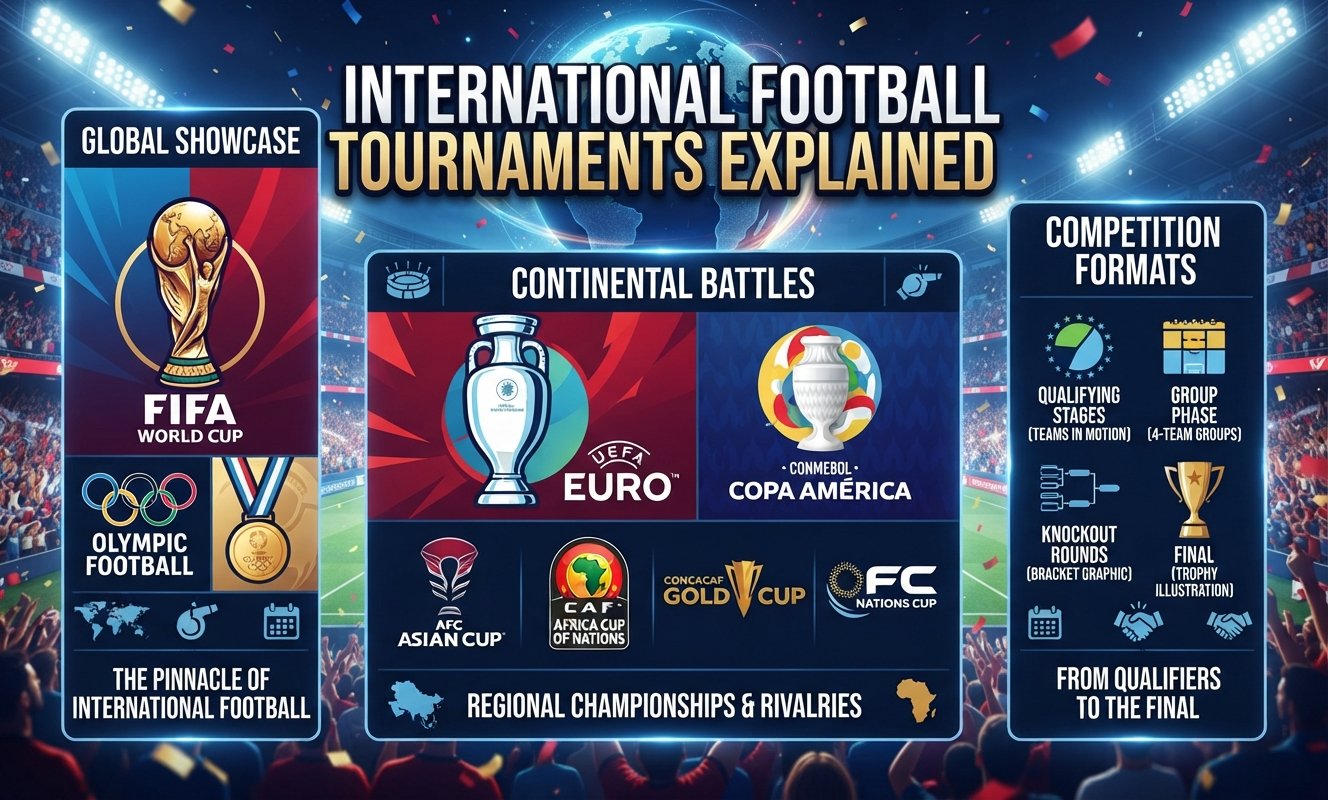
These competitions may be organized globally, such as the FIFA World Cup, or within specific regions, such as the UEFA European Championship, Copa América, AFC Asian Cup, Africa Cup of Nations, and CONCACAF Gold Cup.
Tournament formats vary depending on the competition. Some events feature a qualification process before the main tournament, while others use ranking systems, regional qualification, or automatic qualification for certain teams.
FIFA World Cup
The FIFA World Cup is the most prominent international football tournament. It brings together national teams from around the world and takes place on a four-year cycle.
Teams generally must qualify through regional competitions before reaching the final tournament. Qualification systems differ between confederations, with each region receiving a designated number of places.
The World Cup traditionally includes a group stage followed by knockout rounds. Teams compete for points during the group stage, while successful teams advance toward the knockout phase. The final stages include the round of 16, quarter-finals, semi-finals, and final, depending on the tournament format.
The competition has produced legendary players, historic matches, dramatic comebacks, and memorable finals.
UEFA European Championship
The UEFA European Championship, commonly called the Euros, is one of the major international football tournaments. It features national teams from Europe competing for the continental title.
Teams qualify through a qualification campaign before entering the final tournament. The competition then uses a group stage and knockout rounds.
European football contains many strong national teams, making qualification and tournament progression highly competitive. The Euros have featured players such as Michel Platini, Zinedine Zidane, Andrés Iniesta, Cristiano Ronaldo, and other influential stars throughout different generations.
Copa América
Copa América is the major men’s international tournament in South America. It is organized by CONMEBOL and features national teams from the region, with invited teams sometimes participating depending on the edition.
Countries such as Brazil, Argentina, Uruguay, Chile, Colombia, and Paraguay have played important roles in the tournament’s history.
Copa América matches are often characterized by technical football, strong tactical competition, and intense regional rivalries. The tournament has also provided a major stage for some of the world’s most famous footballers.
AFC Asian Cup
The AFC Asian Cup is the leading men’s international football championship in Asia. National teams from across the continent compete to become Asian champions.
The tournament provides opportunities for established football nations and emerging teams to compete at a continental level. Countries including Japan, South Korea, Saudi Arabia, Iran, Australia, Qatar, and others have developed significant histories within Asian international football.
The competition also demonstrates the increasing diversity of football styles across Asia.
Africa Cup of Nations
The Africa Cup of Nations, organized by the Confederation of African Football, is the principal international men’s football championship in Africa.
The tournament brings together national teams from across the continent. African football has produced numerous internationally recognized players who have gone on to compete for leading European clubs.
The competition is known for its passionate supporters, distinctive football cultures, competitive matches, and strong national identities.
CONCACAF Gold Cup
The CONCACAF Gold Cup is the major men’s international tournament for teams from North America, Central America, and the Caribbean.
The competition features national teams from across the region, with countries such as Mexico, the United States, Costa Rica, Canada, Jamaica, and others regularly participating.
The tournament has contributed to the development and visibility of football across the region and provides an important competitive environment for national teams.
UEFA Nations League
The UEFA Nations League was introduced to provide more meaningful international fixtures between European national teams. Instead of relying primarily on friendly matches, teams compete in a structured league system.
National teams are divided into groups based on competition levels. Matches can influence promotion, relegation, and qualification-related opportunities depending on the tournament edition and regulations.
The Nations League has added another competitive layer to the international football calendar.
Olympic Football
Olympic football has a distinctive format compared with senior international championships. The men’s tournament traditionally uses age restrictions with limited exceptions for older players, while the women’s tournament has different eligibility rules.
The Olympic Games give footballers an opportunity to represent their countries in a multi-sport international event. The women’s Olympic football tournament has become particularly significant, featuring many of the world’s leading national teams.
Youth International Tournaments
International football also includes major youth competitions. FIFA and continental confederations organize tournaments for different age groups, allowing young players to gain international experience.
Youth tournaments can help identify future senior national-team players. Scouts and coaches often pay close attention to technical ability, tactical understanding, physical development, and decision-making.
These competitions also provide developing football nations with opportunities to compete against stronger established programs.
Women’s International Football Tournaments
Women’s football has experienced substantial international growth, with major tournaments attracting increasingly large global audiences.
The FIFA Women’s World Cup is the premier global competition for women’s national teams. Continental tournaments such as the UEFA Women’s Championship, AFC Women’s Asian Cup, Copa América Femenina, and Women’s Africa Cup of Nations also provide important international stages.
Women’s international football has developed through improved professional leagues, youth programs, investment, broadcasting, and greater participation.
How International Tournament Formats Work
Most major football tournaments combine group and knockout stages. During a group stage, teams generally earn points for results. Wins provide three points, draws one point, and defeats zero points under the standard scoring system.
Qualification for the knockout stage depends on the tournament’s regulations. Teams may be separated by points, goal difference, goals scored, head-to-head records, or other official criteria.
Knockout matches must produce a winner. If the score is level after regular time, extra time and a penalty shootout may be used according to the competition rules.
Why International Football Tournaments Matter
International tournaments offer national teams a chance to compete for major trophies while representing their countries. They also bring together different football cultures and tactical philosophies.
For players, performing well internationally can become an important part of their careers. For fans, tournaments create memorable moments that can remain part of national sporting history for generations.
International competitions also influence football development. Successful tournaments can encourage youth participation, investment in facilities, coaching programs, and broader interest in the sport.
Following International Football
Fans can follow international football through official competition websites, national football associations, match schedules, live scores, television broadcasts, and reputable sports publications.
Those researching football-related commercial services may encounter a Sports Betting Agent, but commercial services should be kept separate from official tournament information. For accurate rules, fixtures, results, and disciplinary decisions, official football organizations remain the appropriate sources.
Conclusion
International football tournaments provide a global stage where national teams compete for prestigious trophies and create lasting sporting memories. The FIFA World Cup, UEFA European Championship, Copa América, AFC Asian Cup, Africa Cup of Nations, CONCACAF Gold Cup, and women’s and youth competitions each contribute to the worldwide development of football.
By understanding qualification systems, tournament formats, group stages, knockout rounds, and regional competitions, fans can better appreciate the strategy and history behind international football. As the sport continues to expand globally, international tournaments will remain an important part of football culture and competition.