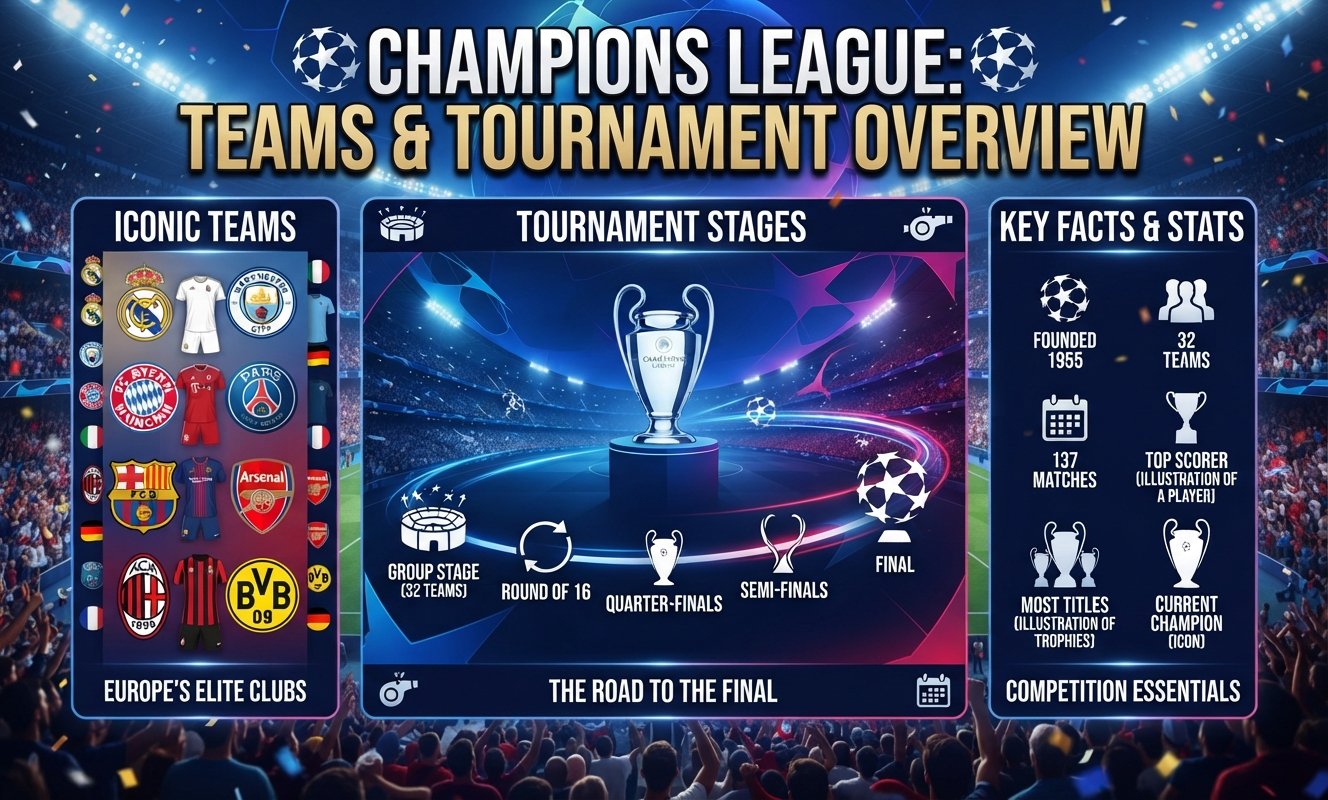
Champions League: Teams & Tournament Overview
The UEFA Champions League is one of the most prestigious club football competitions in the world. Every season, leading European clubs compete for continental glory, bringing together some of the best players, managers, and teams in football. The competition is known for its high-quality matches, historic rivalries, dramatic knockout rounds, and memorable finals.
From the group and league stages to the knockout rounds, the Champions League provides a long and competitive journey toward the European title. Understanding the tournament structure, participating teams, qualification process, and major stages makes it easier for football fans to follow the competition.
What Is the Champions League?
The UEFA Champions League is an annual European club competition organized by UEFA, the governing body of football in Europe. It brings together qualifying clubs from domestic leagues across UEFA member associations.
The competition has a long history and evolved from the European Cup, which was established in the 1950s. Over the decades, it developed into a broader competition featuring clubs from many European countries.
Today, the Champions League represents the highest level of European club football. Winning the competition is a major achievement for clubs because it demonstrates success against strong opponents from different domestic leagues.
Champions League Tournament Structure
The modern Champions League uses a league-phase format rather than the traditional group-stage system that was used for many previous seasons.
In the league phase, participating clubs are placed into a single league table. Each team plays a set number of matches against different opponents rather than facing every other club.
The results determine the league standings. Teams that perform strongly can progress directly to the knockout stage, while others may enter a playoff round depending on their final position.
This format provides more varied fixtures and allows clubs to face opponents they might not otherwise meet during the early part of the competition.
Qualification for the Competition
Qualification for the Champions League is connected to performance in domestic European leagues. The strongest domestic competitions generally receive multiple qualification places, while clubs from lower-ranked associations may need to progress through qualifying rounds.
The qualification system can include several stages, depending on the club’s association ranking and domestic position.
Qualifying matches provide smaller and less established clubs with an opportunity to compete against stronger European opponents. For these teams, reaching the main competition can represent an important sporting and financial milestone.
Famous Champions League Teams
Many of Europe’s most successful and recognizable football clubs have competed in the Champions League.
Real Madrid
Real Madrid has a historic association with European club football and has won the competition numerous times. The Spanish club has featured generations of famous players and has regularly competed at the highest level of European football.
Its long history in the competition has contributed to some of the tournament’s most memorable matches and finals.
Barcelona
FC Barcelona is another major European club with a significant Champions League history. Known for developing technically skilled players and emphasizing possession-based football during several successful periods, Barcelona has produced many memorable European performances.
Bayern Munich
Bayern Munich is one of Germany’s most successful clubs and has consistently competed in Europe’s top club competition. The Bavarian club has combined domestic success with strong performances on the European stage.
Manchester United
Manchester United has a long history in European competition and has won the Champions League on multiple occasions. The club has produced several memorable European campaigns and remains one of the most recognizable English teams.
Liverpool
Liverpool has enjoyed considerable success in European football. Its passionate fan base and history of dramatic European matches have made the club an important part of Champions League culture.
Manchester City
Manchester City has become a major force in European football during the modern era. Significant investment in squad development and coaching has helped the club compete regularly for major domestic and international trophies.
The Knockout Stage
The knockout stage is one of the most anticipated parts of the Champions League. After the league phase and any relevant playoff round, qualifying teams move toward the elimination rounds.
The knockout phase includes stages such as the round of 16, quarter-finals, semi-finals, and final.
Depending on the competition rules, many knockout ties involve two matches, allowing teams to play once at home and once away. The aggregate result determines which club progresses.
The final is different because it is a single match played at a designated venue. The winner of the final becomes European champion.
Why Champions League Fixtures Matter
Every Champions League fixture can have significant consequences. During the league phase, points gained from victories and draws influence a club’s position in the table.
As the competition reaches the knockout stage, individual matches become even more important because elimination can occur after a limited number of games.
Fans often pay particular attention to major fixtures involving clubs with strong European histories. Matches between leading teams can attract audiences from around the world and generate significant international interest.
Key Players and Tactical Battles
The Champions League regularly features some of the world’s leading footballers. Attackers, midfielders, defenders, and goalkeepers must perform at a high level against opponents with different tactical systems.
Managers also play a critical role. Tactical decisions involving formations, pressing systems, defensive organization, substitutions, and possession strategies can influence the result of a match.
A team may need to adapt its approach depending on the opponent. For example, a club facing a possession-oriented team might emphasize defensive transitions and counterattacking opportunities.
Home and Away Football
European knockout football has traditionally placed considerable emphasis on home and away matches. Playing at home can provide teams with familiar surroundings and strong support from their supporters.
Away matches can present different challenges, including travel, unfamiliar stadium conditions, and hostile atmospheres.
The two-leg format also creates strategic considerations. Teams must decide how aggressively to approach the first match while keeping the overall tie in mind.
The Champions League Final
The Champions League final is the concluding match of the tournament. It brings together the two surviving clubs after a long European campaign.
The final is played at a selected stadium and attracts enormous worldwide attention. Winning the final gives the successful club the Champions League trophy and a place in European football history.
Finals can also feature different tactical approaches. Some teams prioritize possession and controlled buildup, while others rely on fast transitions, direct attacks, or defensive organization.
Impact on European Football
The Champions League has a major influence on European club football. Success can enhance a club’s reputation, attract elite players, and provide significant international exposure.
Participation can also help clubs gain experience against different tactical systems and football cultures.
For supporters, the competition creates opportunities to watch clubs from different countries compete against each other. This international element is one of the reasons the tournament has developed such a large global following.
Following Champions League Football
Fans can follow Champions League football through official UEFA resources, club websites, television broadcasters, sports applications, and reputable football publications.
Important information includes fixture dates, kickoff times, results, league standings, team news, player statistics, and disciplinary updates.
When researching football-related commercial services, readers may encounter terms such as Sports Betting Agent. Such commercial information should be kept separate from official tournament facts, fixtures, regulations, and statistics.
Following authoritative sources is particularly useful because fixture schedules, venues, kickoff times, and squad information can change during a long European campaign.
What Makes the Champions League Special?
The Champions League combines elite players, historic clubs, international rivalries, tactical variety, and high-pressure matches. A club can face opponents from several different footballing cultures during one campaign.
The competition also provides opportunities for emerging players to establish themselves on the European stage. Young footballers can gain valuable experience by competing against established international stars.
For supporters, the combination of unpredictable results and high-quality football makes the tournament one of the most closely followed club competitions in the world.
Conclusion
The UEFA Champions League is a central part of European club football, bringing together leading teams from across the continent. Its league phase, qualification system, playoff opportunities, knockout rounds, and final create a demanding path toward the European title.
Clubs such as Real Madrid, Barcelona, Bayern Munich, Manchester United, Liverpool, and Manchester City have all contributed to the competition’s rich history, while countless players and managers have created memorable moments.
By understanding the tournament format, qualification process, major teams, fixtures, knockout stages, and tactical elements, football fans can better appreciate the Champions League and follow each stage of the European football season.