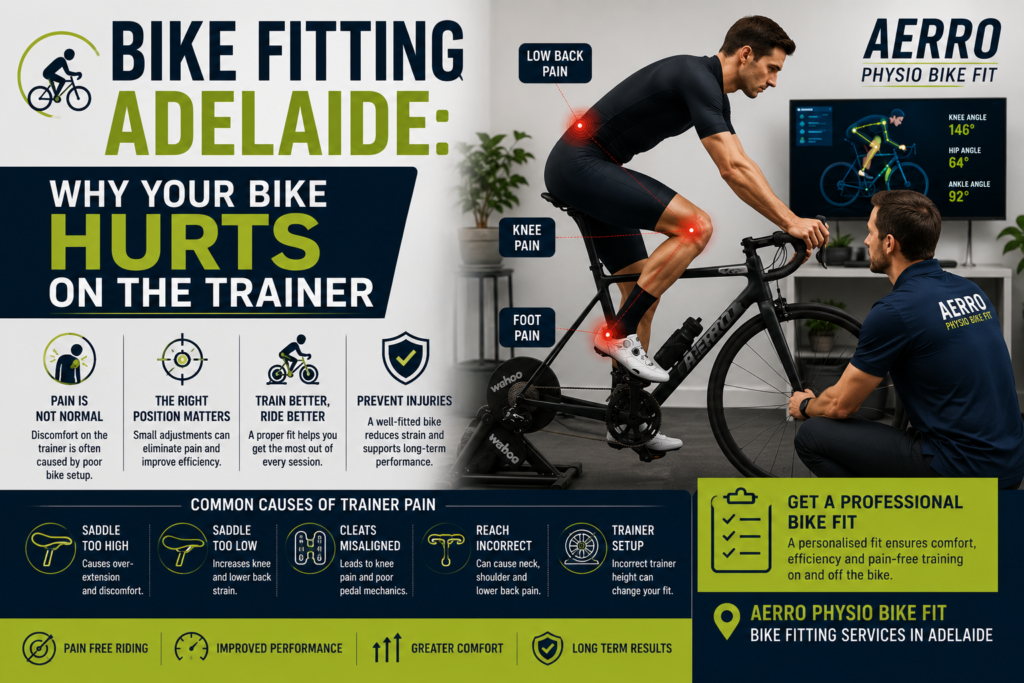
There is a complaint bike fitters hear every summer and every winter, and it always arrives with the same puzzled tone: “The bike is fine on the road — but twenty minutes into a trainer session, my seat / hands / back start complaining. Same bike. Same position. How?”
The rider assumes something about the trainer is wrong. The truth is more useful: nothing about the trainer is wrong, and that is exactly the problem. Indoor riding strips away every small mercy that outdoor riding quietly grants a flawed position — and in doing so, it works as an accidental diagnostic tool. This article explains why positions fail indoors first, what that reveals, and how riders doing serious trainer hours should think about bike fitting Adelaide conditions increasingly demand.
The mercies the road grants and the trainer refuses
Outdoors, no rider holds one position continuously, even when they think they do. The road intervenes constantly:
You coast. Every descent, every corner approach, every red light is a micro-break — pedalling stops, weight shifts, pressure redistributes. You stand — for climbs, for driveways, for the simple relief of it. You move your hands — hoods to drops to tops, dozens of times an hour. The bike leans and yaws beneath you through corners and around potholes, so your contact points are loaded dynamically, never statically. Even wind and gradient changes vary the muscular demand stroke by stroke.
Now remove all of it. On a trainer the bike is rigid and vertical, the resistance never pauses, there is nothing to coast for, nowhere to corner, and no reason to move. The rider settles into one position and pedals continuously — often for an hour or more, frequently at structured intensities the road rarely sustains. Add indoor heat (an Adelaide problem twice over: summer sessions escape the sun only to find the garage), and the dose delivered to every contact point is unlike anything outdoor riding produces.
A marginal saddle angle that the road’s constant interruptions kept below the threshold of complaint gets loaded statically, continuously, sweatily — and crosses it. The trainer did not create the fault. It removed the mercies that were hiding it.
What indoor discomfort is telling you
This reframing matters because it changes what the complaint means. Discomfort that appears indoors first is not a trainer quirk to be managed with a fan and a towel — it is an early warning from a position fault that outdoor riding is still masking.
The usual suspects, by symptom:
Saddle discomfort or numbness indoors. The most common by far. Static, continuous saddle loading exposes marginal tilt, set-back, or pelvic position — the exact faults that produce trouble outdoors later, on the longest and hottest rides, when the road’s mercies run out too.
Hands and wrists. With no reason to move, hands stay planted — and any excess forward weight, tolerable when redistributed every few minutes outdoors, becomes sustained nerve pressure.
Lower back tightening late in sessions. Continuous pedalling with no standing breaks asks the trunk and hips to stabilise without relief; if the position demands flexion at the edge of the rider’s range, the back announces it indoors first.
Knees under structured intensity. Interval work concentrates high-force pedalling in a way variable terrain never quite does — marginal saddle height and cleat faults surface accordingly.
Riders who treat these as trainer problems buy thicker chamois and bigger fans. Riders who treat them as position information get the fault found before the road finds it for them.
The fit implications of serious indoor hours
For riders whose weekly volume now includes substantial trainer time — and between Adelaide’s summer heat, winter darkness, and the structured-training era, that is a large share of committed cyclists — a few fitting consequences follow:
The position must survive its hardest test, which is now indoors. A fit assessed only against outdoor riding is assessed against the gentler exam. Sustained, static, continuous load is the standard a modern position has to meet.
Assessment under sustained load matters more. A fitting process that observes the rider through extended continuous efforts — not just brief spins — is watching the exact conditions where modern positions fail. Watching the position degrade under fatigue is diagnostic gold, and the trainer makes it visible.
The body’s contribution grows. With no coasting or terrain to share the work, trunk endurance and hip mobility carry more of the load. Where those are the limiter, bike adjustment alone will not fix the indoor ache — which is where clinical assessment earns its place, identifying what needs an Allen key and what needs an exercise program.
Small errors compound faster. An hour of trainer time delivers more uninterrupted repetitions in one position than an hour of road time ever does. The dose is higher; the margin for error is smaller.
This is precisely the territory of a physio-led bike fitting studio in Adelaide — where the assessment covers the body as well as the bike, positions are tested under the sustained loads indoor riding actually imposes, and body-side limiters are treated as part of the fit rather than left for the rider to discover mid-January. For riders around the southern and western suburbs, Aerro’s Plympton studio on Anzac Highway makes the follow-up practical too.
Practical indoor-position habits, fit or no fit
Whatever a rider’s fitting status, a few habits reduce the indoor dose:
- Manufacture the mercies the road used to provide. Stand for thirty seconds every ten minutes; change hand positions on a schedule; shift deliberately on the saddle. Outdoors this happened for free — indoors it has to be a habit.
- Take heat seriously. Airflow is a position issue, not just a comfort one: heat amplifies every contact-point problem, saddle issues especially. A proper fan is the cheapest equipment upgrade in indoor cycling.
- Check the setup matches the road bike. Riders using a dedicated trainer bike or wheel-off frame should confirm the position genuinely replicates their documented fit — “close enough” accumulates over a winter of hours.
- Log where and when discomfort appears. Minute-forty saddle trouble on trainer sessions is a data point a fitter can use directly.
And one honest boundary: if discomfort appears indoors and outdoors, or involves pain rather than pressure, skip the habits and get assessed. Management strategies are for marginal positions, not faulty ones.
Conclusion
The trainer is the most demanding position test most riders will ever sit: continuous, static, hot, and merciless about faults the road spent years politely concealing. Discomfort that shows up indoors first is not a quirk of indoor riding — it is an early, useful warning from a position that was always marginal.
The response is the same as for any recurring pattern: treat it as information. For Adelaide riders logging real indoor hours, a bike fit Adelaide summers and structured training genuinely justify should assess the body, observe the position under sustained load, and build a setup that survives the trainer’s exam — because a position that is comfortable through an hour of continuous static effort is comfortable everywhere.
The road forgives. The trainer reports. Listen to the honest one.