Endurance athletes already track almost everything that influences performance.
Power. Pace. Heart rate. Training load. Sleep. Recovery. Nutrition.
Altitude exposure should be approached with the same level of precision.
Simply setting an altitude system to a particular number and assuming the protocol is working is not enough. The athlete needs to know how much exposure has been accumulated, what altitude was actually delivered, and how the body responded.
That shift from simply using altitude to measuring altitude exposure is becoming increasingly relevant for athletes who want a structured approach.
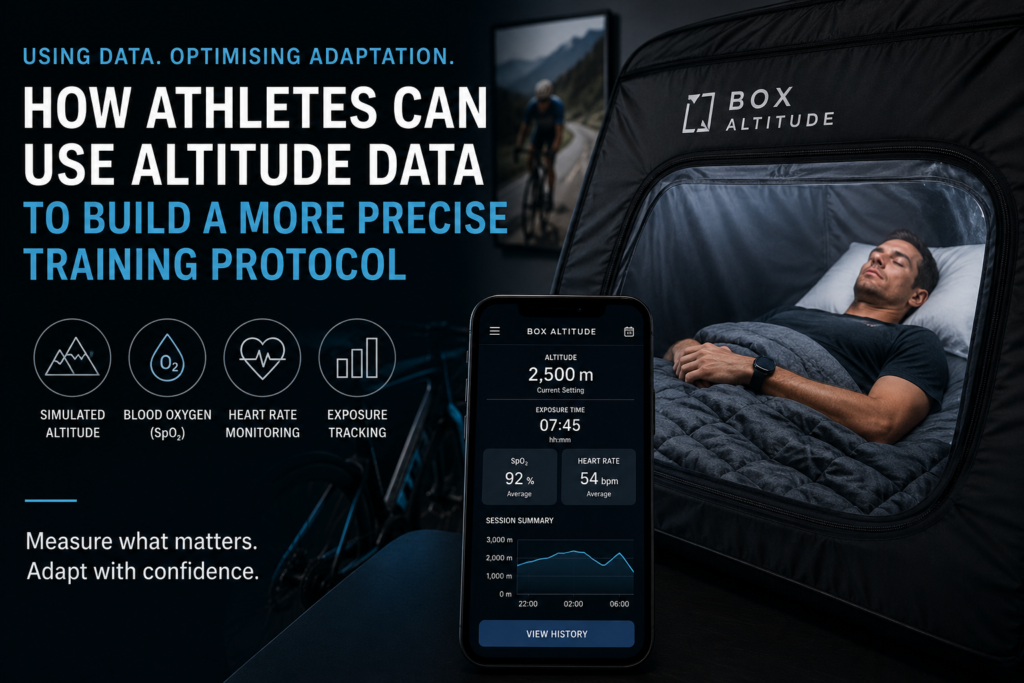
A system such as Box Altitude combines controlled simulated altitude with monitoring tools that allow athletes to record exposure and observe key physiological responses. The objective is straightforward: make the altitude protocol measurable rather than relying entirely on assumptions.
Altitude Is a Dose, Not Just a Number
When athletes talk about altitude, they often focus on the simulated elevation.
2,000 metres.
2,500 metres.
3,000 metres.
But altitude alone does not describe the full exposure.
Duration matters too.
Sleeping at 2,500 metres for one hour is very different from sleeping at the same simulated altitude for eight hours. Repeating that exposure every night for several weeks creates a very different physiological stimulus again.
Research into simulated altitude and the Live High / Train Low model has examined the relationship between altitude level, exposure duration and adaptations such as haemoglobin mass and oxygen carrying capacity. The evidence supports consistent exposure at an appropriate dose, while also showing that individual responses vary.
This is why serious athletes should think in terms of altitude exposure, not simply altitude setting.
Why Exposure Tracking Matters
Imagine an athlete plans a four week altitude block.
The target is 2,500 metres during sleep.
The athlete expects to accumulate a consistent number of hours every week.
But several things can change the actual protocol.
The altitude may be adjusted because of sleep disruption. A night may be shortened because of travel. Training load may require a recovery night. The athlete may lower the setting temporarily during acclimatisation.
Without tracking the exposure, it becomes difficult to understand the actual dose received.
An altitude box with exposure tracking can make this process more transparent.
Box Altitude’s app records altitude session history and exposure hours, while its newer sensor system can also record blood oxygen saturation and heart rate during sessions. These measurements give athletes additional information about how their body responds to the simulated environment.
The value is not in collecting more data for its own sake.
The value is knowing what actually happened.
The Difference Between Target Altitude and Actual Exposure
There is another distinction that matters.
The altitude selected by the athlete is the target.
The environment delivered by the system is the actual exposure.
Those two should correspond closely.
If an athlete sets a system to 2,500 metres but the environment fluctuates significantly from the intended level, the protocol may not be delivering what the athlete thinks it is.
For an athlete running a structured block, consistency matters.
Box Altitude’s app is designed to show the altitude being delivered during a session and maintain a record of the exposure. This gives the athlete a clearer picture of whether the planned protocol is actually being followed.
That is similar to how athletes already manage other training variables.
A cyclist does not simply assume they completed a 300 watt interval because the workout was scheduled. They check the power file.
An athlete using altitude should apply the same thinking.
The protocol is the plan.
The data confirms what actually happened.
Monitoring Blood Oxygen and Heart Rate
Altitude exposure creates a physiological response.
Blood oxygen saturation and heart rate can provide useful context around that response.
At simulated altitude, oxygen availability is reduced. The body responds through changes in ventilation, cardiovascular function and, over longer exposure periods, haematological adaptation.
Tracking blood oxygen saturation can help the athlete understand how their body is responding at a particular simulated altitude. Heart rate can provide another reference point.
Neither measurement should be treated as a direct measurement of haemoglobin mass.
That distinction matters.
The Box Altitude app can record SpO₂ and heart rate during altitude sessions, but these measurements do not replace laboratory testing when an athlete wants to measure a specific physiological outcome such as haemoglobin mass. The app is a monitoring and protocol tracking tool, not a substitute for physiological testing.
That is a more useful way to interpret the technology.
The data helps describe the exposure and response.
It does not pretend to measure everything.
How Coaches Can Use the Data
Altitude training becomes more useful when it is connected to the wider training programme.
A coach can look at exposure hours alongside training load, sleep and recovery.
For example, an athlete may complete a planned altitude session but also experience unusually high training fatigue that week. The coach can consider whether the altitude protocol should remain unchanged or whether the overall load needs adjusting.
Another athlete may tolerate the exposure well and maintain good sleep quality. Their protocol may progress differently.
This is where individualisation matters.
The research does not support the idea that every athlete should follow exactly the same altitude prescription. Factors including exposure duration, altitude level, iron availability, training quality, sleep and individual response can influence the outcome.
Data does not eliminate that variability.
It makes the variability easier to see.
Sleep Quality Should Be Part of the Measurement
There is a simple mistake athletes can make when chasing an altitude target.
They can forget that the primary reason for overnight exposure is to accumulate useful altitude hours while still recovering.
If a higher simulated altitude repeatedly disrupts sleep, increasing the setting may not be the right decision.
The athlete needs to consider the complete picture.
How many hours were spent at altitude?
What was the actual altitude?
What happened to heart rate?
How did oxygen saturation respond?
Was sleep maintained?
How did the athlete feel the following morning?
These questions are more useful than asking whether 3,000 metres sounds better than 2,500 metres.
Box Altitude’s technology is designed around this broader monitoring approach, allowing session history and physiological data to be reviewed rather than treating altitude as an isolated number.
Building a Repeatable Altitude Block
A structured altitude block can then follow a relatively simple process.
First, establish the objective.
The athlete may be targeting endurance adaptation, preparing for competition at altitude or incorporating simulated altitude into a broader performance programme.
Next, establish the intended exposure.
That includes the approximate altitude, duration and number of days or weeks.
Then monitor the actual exposure.
This is where an altitude system with session history becomes useful.
Finally, assess the response alongside the rest of the training programme.
The athlete should not judge the block purely on how high the simulated altitude reached.
The better question is whether the intended exposure was delivered consistently and whether it fitted the athlete’s training and recovery requirements.
Where an Altitude Box Fits Into the Athlete’s Routine
The practical advantage of a home altitude box is that the athlete can make altitude exposure part of an existing routine.
There is no need to travel to a mountain location for every block.
An athlete can train normally during the day and use a controlled environment for overnight exposure. For athletes following the Live High / Train Low model, this separation allows key training sessions to remain at lower altitude while the hypoxic stimulus is accumulated during sleep.
For cyclists, runners and triathletes, that can simplify the weekly schedule.
The athlete is not adding another workout.
They are modifying the environment in which recovery and sleep take place.
That is a different way of thinking about altitude.
Precision Makes the Protocol Easier to Manage
Altitude training does not need to become complicated.
The fundamentals remain straightforward.
Choose an appropriate protocol. Deliver the exposure consistently. Protect training quality. Monitor the response. Adjust when the athlete’s circumstances change.
Technology can make those steps easier to manage.
Box Altitude provides a controlled simulated altitude environment alongside app based monitoring that records exposure and selected physiological measures. For athletes who already approach training through data, this creates a more consistent way to manage altitude as part of the wider programme.
The important point is not having more numbers.
It is having the right numbers connected to a clear protocol.
Altitude training works best when it is treated like training itself.
There is an intended dose.
There is an actual dose.
There is a physiological response.
And there is a training plan that needs to accommodate all three.