IPO GMP Explained: How Grey Market Premium Can Help Investors Understand Market Sentiment
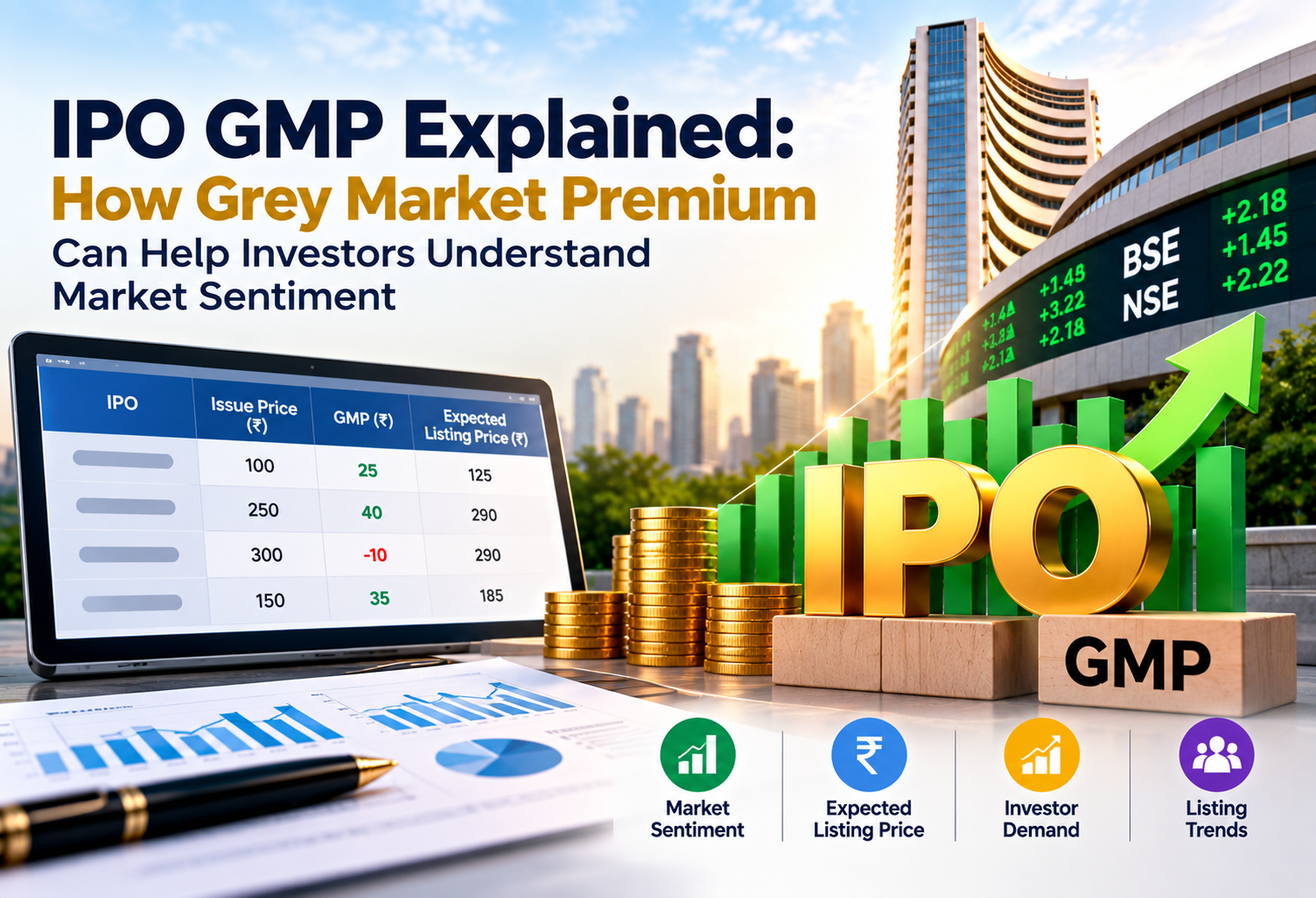
Initial Public Offerings (IPOs) attract significant attention from investors looking for new opportunities in the stock market. Before an IPO lists on a stock exchange, one term that frequently appears in investor discussions is IPO GMP, or Grey Market Premium.
Investors often search for terms such as IPO GMP today, latest IPO GMP, current IPO GMP, live IPO GMP, IPO grey market premium, and expected IPO listing price. But what exactly does GMP mean, and how useful is it when evaluating an IPO?
Understanding GMP can help investors interpret market sentiment, but it is important to remember that it is an unofficial indicator and should not be treated as a guaranteed prediction of listing gains.
What Is IPO GMP?
IPO GMP stands for Grey Market Premium. It refers to the premium at which IPO shares or applications are reportedly traded in the unofficial grey market before the shares are listed on a recognised stock exchange.
For example, if an IPO has an issue price of ₹100 per share and the reported GMP is ₹20, the implied GMP-based price would be approximately ₹120.
The basic calculation is:
Estimated Listing Price = IPO Issue Price + GMP
In this example:
- IPO Issue Price: ₹100
- GMP: ₹20
- Indicative GMP-based price: ₹120
- Indicative premium: 20%
This is only an illustration. The actual listing price can be significantly different from the GMP-based estimate.
For investors who want a detailed explanation, the IndiaIPO guide on what IPO GMP is and how to use GMP before applying provides additional information about GMP, its calculation and practical interpretation.
How Does the IPO Grey Market Work?
The grey market operates outside the formal stock-exchange trading system. Transactions in this market are unofficial and do not have the same regulatory framework and protections as transactions executed through recognised exchanges.
GMP therefore represents an informal indication of what some market participants are willing to pay for an IPO before its official listing.
Other terms associated with the IPO grey market can include:
- GMP: Grey Market Premium
- Kostak Rate: A fixed amount associated with an IPO application
- Subject to Sauda: A conditional grey-market arrangement linked to allotment
Because the grey market is unofficial, investors should be particularly careful when relying on information from informal sources.
Why Do Investors Track IPO GMP?
The main reason investors follow GMP is to understand market sentiment before an IPO listing.
A rising GMP may indicate increasing optimism among grey-market participants, while a falling GMP can suggest weakening sentiment.
However, the direction of GMP can sometimes be more informative than a single number.
For example:
GMP rising: ₹20 → ₹35 → ₹50
This could indicate increasing market optimism.
On the other hand:
GMP falling: ₹80 → ₹60 → ₹35
This may suggest that enthusiasm is declining.
The movement should therefore be considered alongside subscription data, company fundamentals and broader market conditions.
IPO GMP and Expected Listing Price
One of the most common uses of GMP is estimating a possible listing price.
Suppose an IPO has:
- Issue price: ₹150
- GMP: ₹30
The indicative GMP-based listing price would be:
₹150 + ₹30 = ₹180
The implied premium would be:
₹30 ÷ ₹150 × 100 = 20%
However, this should not be interpreted as a guaranteed 20% listing gain.
The actual listing price is determined by buying and selling activity on the stock exchange after listing.
Can IPO GMP Predict Listing Gains?
No, IPO GMP cannot guarantee listing gains.
GMP is an unofficial market-sentiment indicator. It can change rapidly before listing and may differ from the actual market price once trading begins.
Several factors can cause the actual listing price to differ from the GMP-based estimate, including:
- Overall stock-market conditions
- Investor sentiment
- IPO subscription levels
- Institutional participation
- Company fundamentals
- Valuation
- Sector performance
- Market volatility
- Demand and supply on listing day
This is why investors should use GMP as one research input rather than the final investment decision.
How to Use GMP Before Applying for an IPO
A disciplined approach to IPO analysis involves combining GMP with other available information.
1. Track the GMP Trend
Rather than checking GMP only once, monitor how it changes during the IPO subscription period.
A stable or gradually rising GMP may provide a different signal from a highly volatile GMP that changes dramatically within a short period.
2. Compare GMP With Subscription Data
Subscription figures can provide additional information about investor demand.
For example, a high GMP accompanied by strong subscription across investor categories may indicate broader demand than a high GMP with relatively weak subscription.
3. Check QIB Participation
Qualified Institutional Buyer (QIB) participation is another important data point.
Institutional investors generally conduct detailed analysis before investing, so QIB subscription can provide useful context when evaluating market demand.
4. Study Company Fundamentals
GMP should never replace fundamental analysis.
Investors should consider:
- Revenue growth
- Profitability
- Debt
- Cash flows
- Business model
- Competitive position
- Industry outlook
- Valuation
5. Consider the Broader Market
Market conditions around the expected listing date can have a significant influence on IPO performance.
A strong GMP during a highly volatile or declining market may not translate into the expected listing performance.
High GMP Does Not Always Mean a Good IPO
One of the biggest mistakes investors can make is assuming that a high GMP automatically means an IPO is attractive.
A high GMP can sometimes reflect short-term speculation, market excitement or limited grey-market liquidity rather than the long-term quality of the company.
Similarly, a low GMP does not necessarily mean that a company has poor long-term prospects.
GMP primarily reflects short-term market expectations, whereas fundamental analysis focuses on the company’s longer-term business prospects.
What Does Negative GMP Mean?
A negative GMP means that the reported grey-market price is below the IPO issue price.
For example:
- Issue price: ₹100
- Reported GMP: -₹10
- Indicative grey-market price: ₹90
This can indicate weak short-term sentiment toward the issue.
However, even a negative GMP should not automatically be treated as proof that the company is fundamentally weak. Investors should investigate the reasons behind market sentiment and examine the company’s financial and business fundamentals.
GMP for Mainboard and SME IPOs
GMP is followed for both Mainboard IPOs and SME IPOs, but the reliability and liquidity of grey-market indications can vary.
SME IPOs may have smaller issue sizes and comparatively thinner trading conditions. Consequently, GMP figures for some SME issues can be more volatile.
Investors should therefore be cautious about interpreting a sharp GMP movement as a definitive market consensus.
IPO GMP vs Actual Listing Price
The most useful way to understand GMP is to compare the estimated price with the actual listing outcome.
For example:
| Metric | Example |
|---|---|
| IPO Issue Price | ₹100 |
| Reported GMP | ₹25 |
| GMP-Based Estimated Price | ₹125 |
| Actual Listing Price | ₹118 |
| Difference | ₹7 |
This comparison demonstrates why GMP should be treated as an estimate rather than a guaranteed listing forecast.
Historical comparisons can help investors understand how closely grey-market expectations matched actual listing prices across different IPOs.
When Should Investors Be Careful With GMP?
There are several situations where GMP should be interpreted cautiously:
Extremely High GMP
An unusually high GMP can sometimes reflect speculative enthusiasm rather than sustainable demand.
Rapid GMP Changes
Sharp movements within a short period may indicate a highly speculative market.
Small or Thinly Traded IPOs
Limited grey-market activity can make reported GMP figures less representative.
Weak Fundamentals
A strong GMP should not override concerns about debt, profitability, valuation or business risks.
Volatile Stock Market
Broader market conditions can change between the end of the IPO subscription period and listing day.
Where Can Investors Get IPO Advisory Support?
Investors and companies should distinguish between IPO market information and professional IPO advisory.
For companies planning an IPO, IndiaIPO provides services covering different stages of the public-market journey, including pre-IPO funding, IPO advisory, SME IPO, Mainline IPO and FPO services. The IndiaIPO IPO Services page provides an overview of these advisory and listing pathways.
The service covers areas such as IPO readiness, eligibility assessment, DRHP preparation, regulatory processes, investor roadshows, book building, allotment and listing support.
For investors researching GMP specifically, the detailed IPO GMP guide explains how GMP can be combined with subscription data and fundamental analysis before making an IPO application.
A Simple IPO GMP Checklist
Before relying on an IPO GMP figure, investors can ask:
- Is the GMP rising or falling?
- How strong is the IPO subscription?
- What is the QIB subscription level?
- What are the company’s financial fundamentals?
- Is the IPO valuation reasonable?
- What are the major risk factors?
- What is the broader market condition?
- Is the GMP based on reliable and consistent information?
If these factors point in different directions, investors should avoid making a decision based solely on GMP.
Final Thoughts
IPO GMP can be a useful indicator of short-term market sentiment, but it is not a guarantee of listing gains.
The most effective way to use GMP is to combine it with IPO subscription data, QIB participation, company fundamentals, valuation and broader market conditions.
Investors interested in understanding the concept in greater detail can read the IndiaIPO guide on what IPO GMP means and how to use it before applying.
Companies planning to enter the public market can also explore IPO Services by IndiaIPO for information about IPO advisory, Mainline IPO, SME IPO, Pre-IPO and FPO services.
Disclaimer: This article is for educational and informational purposes only. Grey Market Premium is unofficial and does not guarantee the actual listing price or investment returns. Investors should conduct independent research, review official offer documents and consider their financial objectives and risk tolerance before investing.