The New Era of Instant Decisions Through Computer Vision
Modern businesses operate in environments where small delays can create significant consequences. A vehicle approaching a restricted entrance, a missing component on a production line, or an unexpected movement inside a warehouse may require immediate attention. Traditional monitoring methods often depend on employees noticing these events and deciding what to do next. Computer vision is changing this process by allowing machines to analyze visual information and identify important situations as they happen.
Real Time Object Detection is one of the technologies driving this change. It enables computer systems to recognize and locate objects within live video streams, giving businesses access to visual information without relying entirely on manual observation. When combined with object tracking, automated alerts, and connected software, it can help organizations respond more quickly and make better-informed operational decisions.
Computer Vision Is Changing How Machines Interpret the World
For many years, computers mainly worked with information entered through documents, databases, and digital forms. Cameras provided another source of information, but their primary purpose was to capture and store images.
Computer vision gives machines the ability to interpret visual information. Using artificial intelligence and image-processing techniques, systems can identify objects, recognize patterns, estimate positions, and analyze movement.
This capability has expanded the role of cameras across different industries. Instead of simply recording what happens, intelligent systems can identify selected activities and communicate their findings to connected applications.
For example, a manufacturing system may recognize a product moving along a conveyor belt, while a traffic monitoring platform can identify different vehicle categories. A warehouse application may detect a forklift entering a designated area and notify the relevant team.
The value comes from converting visual information into results that can support practical decisions.
How Real Time Object Detection Supports Instant Decisions
Real-time decision support depends on several connected technologies. The system must capture visual information, analyze it accurately, and deliver useful results quickly enough for the intended application.
Capturing and Preparing Video Frames
The process begins with a camera capturing its surroundings. Video is divided into individual frames, which are prepared for analysis by a computer vision model.
Depending on the system, frames may be resized or adjusted before processing. The frequency of analysis also matters. Processing more frames can provide more frequent updates, but it increases computing requirements.
The right configuration depends on the speed of the objects, the required level of detail, and the available processing hardware.
Recognizing Objects Through AI Models
After preparation, an artificial intelligence model examines each frame to identify objects it has been trained to recognize.
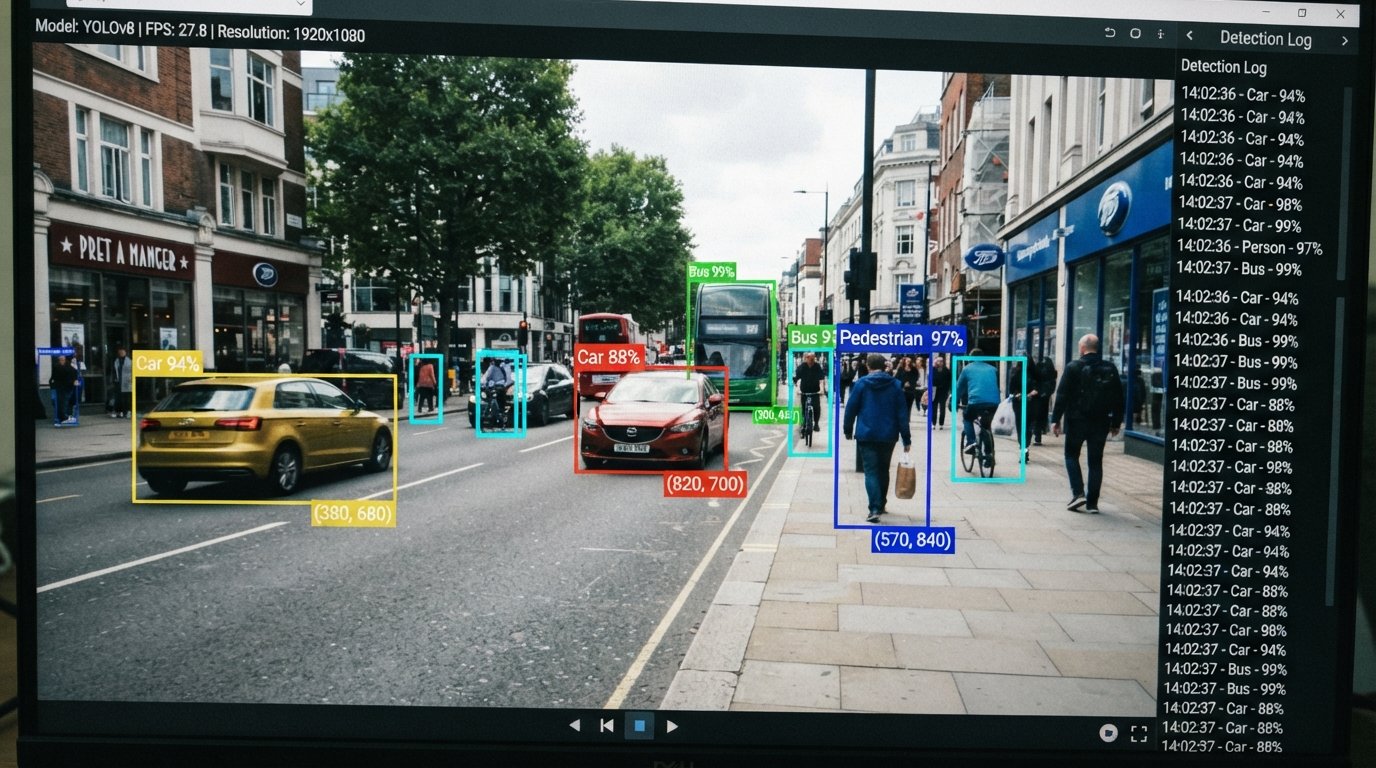
These objects may include people, vehicles, packages, machinery, tools, animals, or products. The model can also estimate their positions using bounding boxes and provide confidence scores for its predictions.
Real Time Object Detection makes these results available while the video is being processed. This allows connected systems to work with current visual information instead of depending only on previously recorded footage.
Tracking Objects Across Multiple Frames
Object detection identifies objects in individual frames, but many applications need to understand how those objects move.
Tracking technology connects detections across consecutive frames. It can follow a vehicle through a monitored area, monitor a package moving along a conveyor, or track a person walking through a facility.
This additional information helps systems understand movement patterns and identify events that cannot be explained by a single image.
Connecting Detection Results to Business Actions
The final stage is turning visual analysis into an operational response.
A system may generate an alert when a vehicle enters a restricted zone, update a dashboard when an object is detected, or save an event for later investigation. More advanced applications can share detection results with inventory, security, or facility management software.
Automated responses should be based on clearly defined rules. In situations involving safety, security, or important business decisions, human verification may still be necessary.
Why Instant Visual Decisions Matter to Modern Businesses
Businesses increasingly rely on fast information to manage complex operations. When important events remain unnoticed, delays can affect productivity, security, customer service, and operational costs.
Computer vision provides another way to identify events and make information available to the people responsible for responding.
Its benefits include several practical improvements.
- Faster event awareness: Important objects and activities can be identified as video is captured.
- Reduced manual observation: Employees can focus on relevant alerts instead of continuously watching every camera.
- Improved operational control: Managers can gain better visibility into activity across different locations.
- More consistent monitoring: Automated systems can apply the same detection rules across multiple camera feeds.
- Better use of recorded information: Detection results can help organize footage and make investigations more efficient.
- Support for data-driven decisions: Visual events can contribute to reports and operational analysis.
However, the quality of these benefits depends on detection accuracy, camera conditions, system configuration, and how effectively the technology is integrated into existing workflows.
Industry Applications of Real Time Object Detection
The ability to identify objects instantly has practical value in industries where visual information influences everyday decisions. Different sectors use the technology according to their specific operational requirements.
Manufacturing and Industrial Automation
Manufacturing facilities contain moving products, machinery, workers, and materials. Monitoring all these activities manually can be difficult, particularly when production lines operate continuously.
Real Time Object Detection can help identify products, components, and equipment during production. A computer vision system may check whether a required component is present or detect an object entering an unsafe machine area.
For example, if a production line requires several components before an item moves forward, an intelligent camera can identify whether the expected items are visible. A missing component may trigger an alert for an operator to inspect the process.
These applications can support quality control and improve awareness of production activities.
Transportation and Road Management
Roads and transport networks generate continuous visual information. Cameras capture cars, buses, trucks, cyclists, and pedestrians, but traditional monitoring often depends on people observing the footage.
Intelligent systems can recognize vehicle categories, estimate traffic density, and detect objects obstructing roadways. When tracking is added, the system can follow vehicles through monitored areas and provide additional information about movement.
Transport authorities may use these insights to understand traffic patterns and identify situations that require attention.
Warehousing and Logistics
Warehouses depend on the organized movement of packages, pallets, vehicles, and employees. A delay in one area can affect several connected activities.
Computer vision can help identify objects moving through loading zones, storage areas, and distribution facilities. Detection systems may recognize forklifts, packages, and vehicles while tracking technology helps monitor their movement.
A warehouse could use this information to identify activity around loading areas or investigate repeated delays. When connected with suitable management software, detection events can also support operational reporting.
Retail and Customer Environments
Retail stores can use intelligent cameras to understand activity around shelves, checkout areas, and entrances.
Object detection may help recognize products, identify empty shelf spaces, and support inventory monitoring. For example, a system could detect when a particular shelf section appears empty and notify store employees.
Some applications also analyze customer movement patterns within selected areas. These systems must be designed with appropriate privacy protections and should collect only information necessary for legitimate business purposes.
Healthcare and Facility Monitoring
Healthcare facilities contain complex environments where staff, equipment, patients, and visitors move between different areas.
Computer vision may help monitor the presence of selected equipment, identify objects in designated locations, or support access monitoring in restricted areas.
For instance, a facility could use object detection to check whether essential equipment is available in a monitored section. Such applications can support operational coordination, but they must follow strict privacy and security requirements.
Security and Access Management
Security teams often manage several camera feeds across offices, commercial buildings, industrial sites, and public infrastructure.
Intelligent video systems can identify vehicles entering controlled locations, detect objects crossing virtual boundaries, and generate alerts when selected conditions occur.
This can help security personnel prioritize important events. However, detection results should be reviewed carefully before taking actions that could affect a person’s access, safety, or rights.
The Technologies That Make Real-Time Decisions Possible
Object detection is only one part of a larger computer vision environment. Several technologies work together to turn visual analysis into useful information.
Artificial Intelligence and Machine Learning
AI models learn to recognize objects through training data containing labeled examples. Their performance depends on the quality and variety of this data.
A model designed for traffic monitoring may recognize cars and pedestrians, while an industrial model may focus on machinery, components, and production materials. Selecting the correct model is essential for achieving useful results.
Edge Computing
Processing video close to the camera can reduce the time required to transfer information to a remote server. This approach is known as edge computing.
Edge devices can analyze video locally and send selected detection results to other systems. This may reduce network usage and improve response speed, although hardware limitations and maintenance requirements must be considered.
Cloud Computing and Centralized Analytics
Cloud infrastructure can provide the computing resources needed to process information from multiple locations. It also supports centralized dashboards, reporting, and system management.
Organizations may combine cloud and edge processing depending on their requirements. The decision depends on latency, data sensitivity, network availability, computing costs, and operational scale.
Integration With Business Software
Detection results become more valuable when they can be shared with existing applications.
For example, a warehouse system may connect visual detections with inventory records, while a facility management platform may receive alerts from cameras monitoring selected areas.
This integration helps organizations move from isolated camera monitoring toward connected operational processes.
Challenges Behind Accurate Instant Decisions
Although computer vision has advanced considerably, real-time systems still face technical and operational challenges.
One important issue is detection accuracy. Poor lighting, camera movement, shadows, reflections, and overlapping objects can affect model performance. A system may incorrectly identify an object or fail to detect something that is partially hidden.
Processing speed is another consideration. High-resolution video and multiple simultaneous camera feeds can create significant computing demands. Organizations must balance processing speed, accuracy, and infrastructure costs.
Data quality also plays an important role. A model trained under limited conditions may not perform reliably in a different environment. Testing with representative footage helps identify weaknesses before deployment.
Privacy and cybersecurity should also be part of the planning process. Organizations need suitable access controls, secure storage, clear retention policies, and responsible video-processing practices.
Finally, automated systems should not be treated as completely independent decision-makers. Human oversight remains important when the consequences of an incorrect detection could be significant.
The Future of Instant Decisions Through Computer Vision
Computer vision is moving beyond basic object recognition toward more advanced visual understanding. Future systems are expected to combine detection, tracking, activity recognition, and information from multiple sensors.
This development may allow organizations to identify more complex situations and connect visual events with broader business processes.
For example, an intelligent industrial platform could combine camera detections with equipment sensor information to provide a clearer picture of production conditions. A transport system could combine traffic camera data with other infrastructure information to improve monitoring.
Advances in AI models and edge computing may also make intelligent vision more accessible to smaller facilities and businesses.
As these systems become more capable, organizations will need to focus on reliable testing, responsible data practices, and clear procedures for human review.
Final Thought
The ability to make timely decisions depends on having useful information at the right moment. Computer vision is helping businesses achieve this by turning visual information into structured insights that can support everyday operations.
Real Time Object Detection plays an important role in this development. It allows machines to recognize objects, identify their positions, and provide information while events are unfolding.
From factories and warehouses to roads, retail stores, and security environments, this technology is changing how organizations understand their surroundings. Its greatest value will come from combining fast detection with accurate analysis, practical software integration, and responsible human oversight.