
Why Thales Key Management Is Important for Enterprises Managing Multiple Encryption Platforms
Introduction
Enterprise IT infrastructure has become increasingly distributed.
Organizations may use multiple cloud providers, on-premises data centers, SaaS applications, enterprise databases, backup platforms, APIs, and specialized business applications.
Each environment can use encryption to protect sensitive information.
While encryption strengthens data protection, it also creates another responsibility: managing the cryptographic keys that support encryption.
When organizations operate several encryption platforms, key management can become fragmented.
Different teams may create keys independently, use different policies, and maintain separate processes for access, rotation, backup, and retirement.
This can make it difficult for security teams to maintain a complete view of the organization’s cryptographic environment.
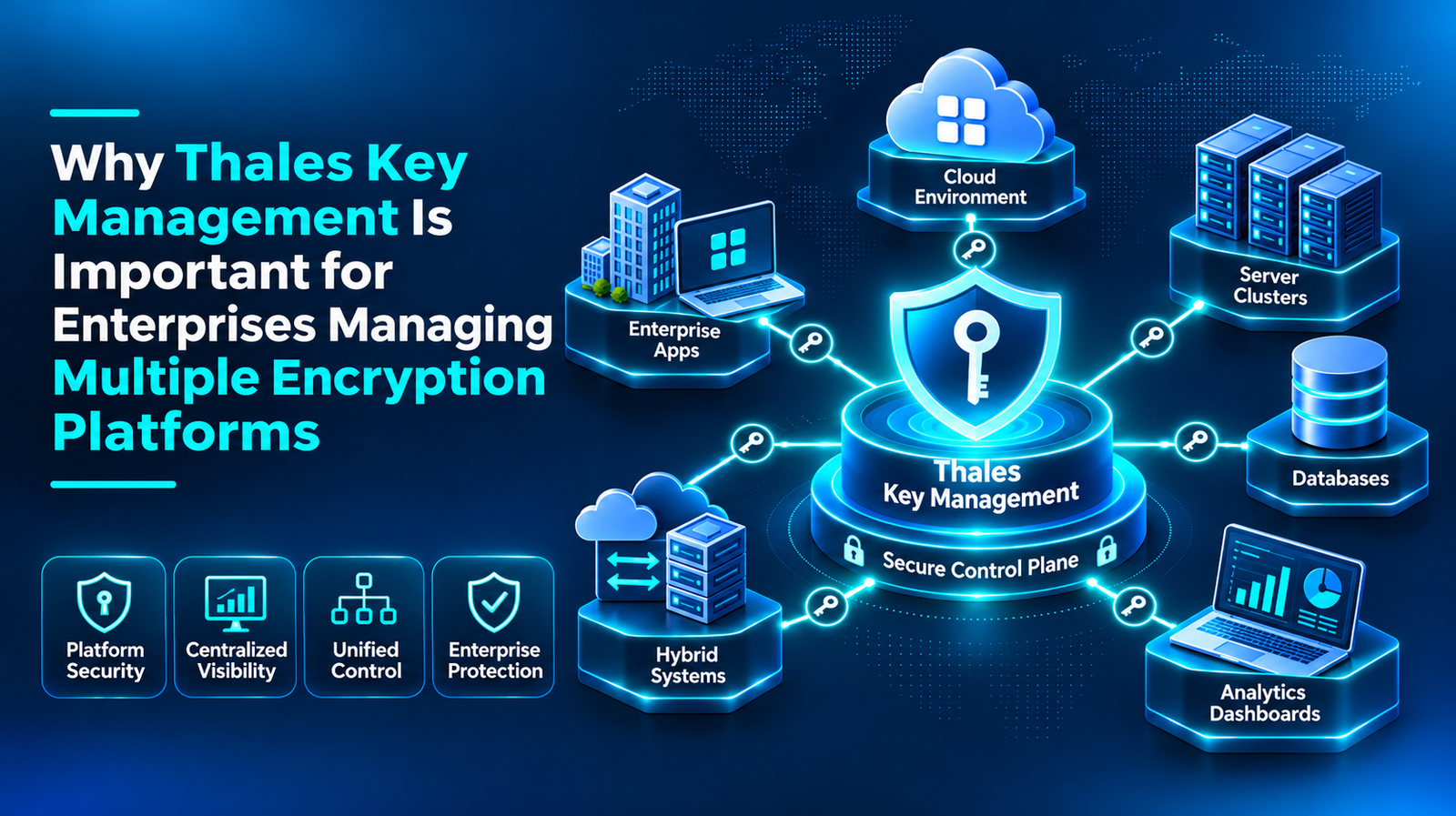
Thales key management can support enterprises seeking centralized capabilities for managing cryptographic keys across complex technology environments.
The Challenge of Multiple Encryption Platforms
An enterprise may use different encryption mechanisms for different workloads.
For example:
- Cloud storage may use one encryption service
- Databases may use another
- Applications may use separate cryptographic libraries
- Backup platforms may maintain their own keys
- Digital certificates may use another key infrastructure
Each platform may have different administrative processes.
Without centralized governance, security teams may struggle to maintain consistent policies.
Why Centralized Key Management Matters
Centralized Key management provides a common framework for managing cryptographic assets.
Instead of allowing each application team to establish completely independent processes, security teams can define enterprise-wide requirements.
These can include:
- Key ownership
- Access control
- Rotation
- Backup
- Recovery
- Monitoring
- Retirement
Centralization can improve visibility and reduce operational fragmentation.
Understanding Key Management in Cryptography
Key management in cryptography covers the lifecycle of cryptographic keys.
This includes:
- Generation
- Storage
- Distribution
- Access
- Usage
- Rotation
- Backup
- Recovery
- Expiration
- Retirement
- Destruction
Organizations need controls throughout this lifecycle.
Thales Key Management
Thales key management can support organizations that need centralized management of cryptographic keys across different enterprise systems.
A centralized approach can help security teams maintain greater control over:
- Key access
- Key lifecycle
- Key ownership
- Rotation
- Monitoring
- Recovery
The exact architecture should depend on the organization’s existing platforms, integrations, security requirements, and operational model.
Improving Key Visibility
One of the biggest challenges of managing multiple encryption platforms involves visibility.
Security teams need to understand:
- Which keys exist
- What each key protects
- Where the key is used
- Who owns it
- Which applications can access it
- When it should rotate
Centralized management can help organizations organize this information more effectively.
Reducing Key Sprawl
Key sprawl occurs when organizations create and maintain more cryptographic keys than they can effectively track.
It can happen when individual teams create keys for new applications without following centralized processes.
Over time, the organization may accumulate:
- Unused keys
- Duplicate keys
- Unknown keys
- Keys with excessive permissions
- Keys belonging to retired applications
Regular inventory reviews can help reduce this problem.
Managing Access Across Platforms
Different encryption platforms may have different access models.
However, organizations can establish common enterprise security principles.
Least privilege should remain a central requirement.
Users and applications should receive only the key access required for their approved functions.
Key Rotation Across Encryption Platforms
Key rotation can become difficult when an organization uses multiple encryption platforms.
Security teams need to understand application dependencies before replacing keys.
For example, a database encryption key may be used by several applications and backup systems.
Organizations should identify these dependencies before initiating rotation.
Centralized governance can help coordinate the process.
Managing Cloud Encryption
Cloud adoption creates additional encryption requirements.
Enterprises may operate workloads across multiple cloud providers.
Each platform may offer its own encryption services.
Organizations should establish consistent enterprise policies while adapting implementation to the technical requirements of each cloud environment.
Managing On-Premises Encryption
On-premises systems often continue to host critical enterprise applications.
The keys protecting these systems should remain part of the broader Key management strategy.
Organizations should avoid allowing on-premises encryption keys to become disconnected from enterprise governance.
Supporting Hybrid Encryption
Hybrid environments combine cloud and on-premises infrastructure.
A business may store sensitive information in an on-premises database while processing it through a cloud application.
This creates cross-platform cryptographic dependencies.
Centralized Key management can help organizations maintain consistent access and lifecycle policies.
Protecting Database Encryption Keys
Databases frequently contain sensitive information.
Organizations may encrypt:
- Customer records
- Financial data
- Employee information
- Transaction data
The associated keys should receive strong protection.
Security teams should monitor who and what can access database encryption keys.
Protecting Application Keys
Applications may use cryptographic keys for:
- Data encryption
- API authentication
- Digital signatures
- Secure communication
Developers should avoid hard-coding sensitive keys into application code.
Applications should use approved cryptographic services instead.
Digital Certificates and Key Management
Digital certificates rely on cryptographic keys.
Organizations should track:
- Certificate ownership
- Expiration
- Private key protection
- Renewal
- Replacement
- Retirement
These activities should form part of the enterprise Key management lifecycle.
Monitoring Cryptographic Activity
Centralized visibility can help security teams monitor:
- Key access
- Key creation
- Key rotation
- Administrative changes
- Failed access attempts
- Key retirement
Monitoring can help identify unusual behavior across different encryption platforms.
Supporting Governance
Centralized management can also support enterprise governance.
Organizations can maintain records related to:
- Key ownership
- Access permissions
- Rotation history
- Lifecycle status
- Administrative activity
This can help security teams conduct periodic reviews.
Common Challenges
Platform Fragmentation
Different encryption platforms may operate independently.
Inconsistent Policies
Teams may apply different lifecycle rules.
Key Sprawl
Large environments can accumulate unnecessary keys.
Complex Integrations
Applications may depend on several encryption services.
Legacy Systems
Older systems may not support modern centralized processes.
Best Practices
Enterprises should:
- Create a complete cryptographic inventory
- Define enterprise Key management policies
- Assign key ownership
- Apply least privilege
- Separate keys from protected data
- Establish rotation procedures
- Automate suitable lifecycle tasks
- Monitor cryptographic activity
- Protect key backups
- Test recovery
- Review access regularly
- Retire obsolete keys
Evaluating a Centralized Approach
Before implementing centralized management, organizations should map their existing encryption infrastructure.
They should identify:
- Encryption platforms
- Key dependencies
- Applications
- Databases
- Cloud services
- Ownership
- Compliance requirements
This assessment can help organizations design a practical implementation strategy.
Conclusion
Managing encryption across multiple platforms can create significant operational and security challenges.
Organizations need consistent policies, clear ownership, visibility, access control, lifecycle management, and monitoring.
Thales key management can support enterprises seeking centralized control of cryptographic keys across distributed encryption environments.
Key management in cryptography provides the lifecycle framework needed to manage keys from generation through retirement.
Effective Key management can reduce fragmentation, improve visibility, simplify lifecycle operations, and strengthen governance.
By combining centralized management with platform-specific integration and strong enterprise security policies, organizations can maintain better control over encryption across their increasingly complex IT infrastructure.