Why Thales Key Management Matters for Enterprises Managing Large Volumes of Encryption Keys
Introduction
Encryption has become a fundamental component of enterprise cybersecurity.
Organizations use encryption to protect customer records, financial information, employee data, intellectual property, application information, databases, backups, and cloud storage.
Every encryption process depends on cryptographic keys.
As organizations grow, the number of cryptographic keys can increase significantly. Large enterprises may operate thousands of keys across applications, databases, cloud platforms, digital certificates, APIs, and other systems.
Managing these keys independently can create considerable complexity.
Security teams need to know which keys exist, what they protect, who can access them, when they should rotate, and whether they remain necessary.
This makes centralized Key management increasingly important.
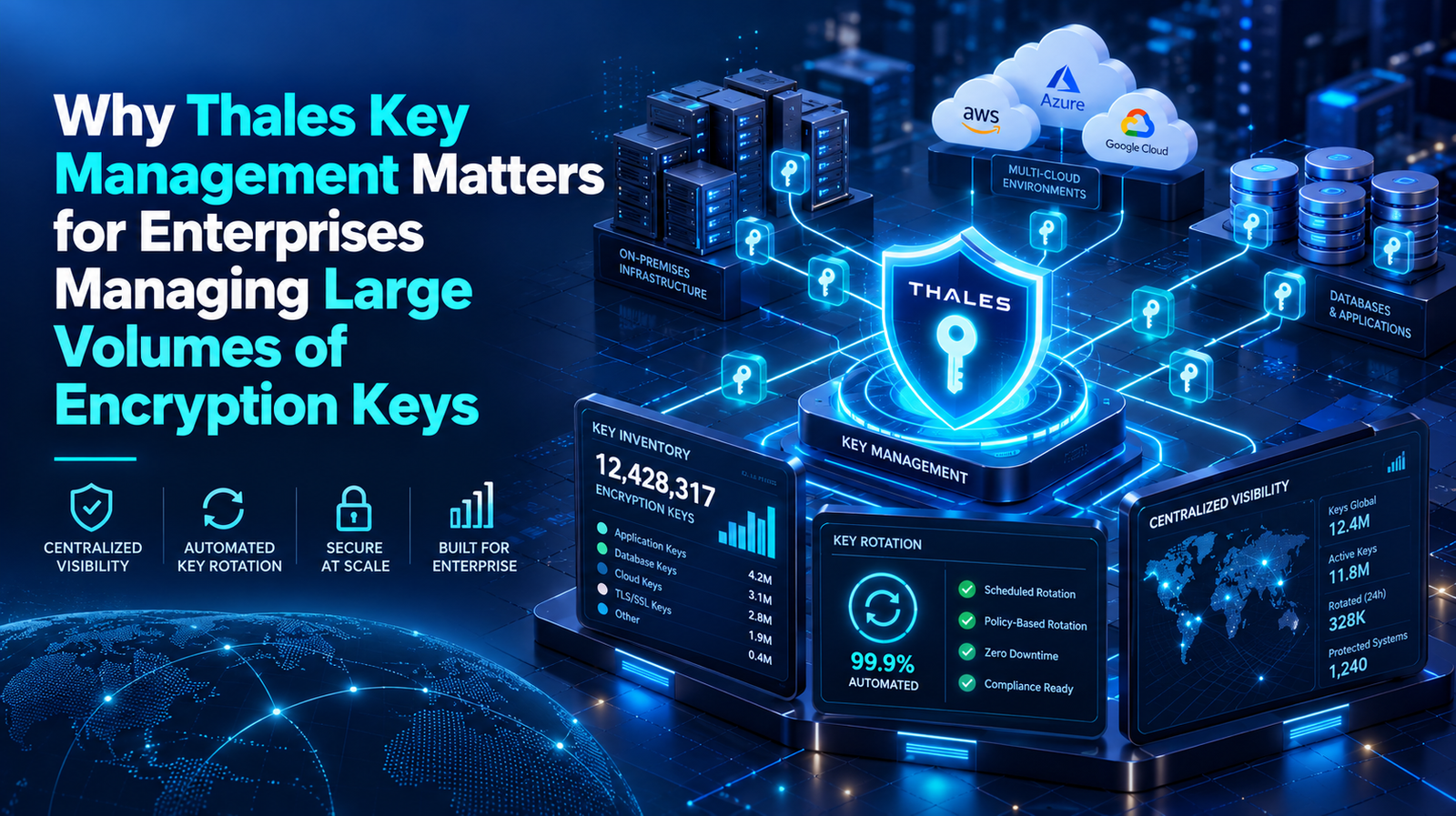
Thales key management can support enterprises that need centralized capabilities for managing cryptographic keys across distributed environments.
Why Large Key Environments Create Challenges
A growing enterprise may operate:
- Multiple cloud platforms
- On-premises data centers
- Enterprise databases
- SaaS applications
- Mobile applications
- APIs
- Backup systems
- Digital certificate infrastructure
Each environment can introduce additional cryptographic requirements.
Without centralized management, security teams may struggle to maintain consistent policies.
Understanding Key Management in Cryptography
Key management in cryptography refers to the processes and controls used to manage cryptographic keys throughout their lifecycle.
The lifecycle generally includes:
- Generation
- Storage
- Distribution
- Access
- Usage
- Rotation
- Backup
- Recovery
- Retirement
- Destruction
Each stage requires appropriate security controls.
The Problem of Key Sprawl
Key sprawl occurs when an organization accumulates large numbers of cryptographic keys without maintaining sufficient visibility or control.
For example, different application teams may create their own keys for databases, cloud storage, and application encryption.
Over time, security teams may lose track of:
- Key ownership
- Key purpose
- Key status
- Key location
- Rotation schedules
This creates operational and security challenges.
How Centralized Key Management Helps
Centralized Key management provides a common framework for managing cryptographic assets.
Security teams can establish policies around:
- Key creation
- Access
- Ownership
- Rotation
- Backup
- Recovery
- Retirement
Centralization can also make it easier to maintain an enterprise-wide key inventory.
Thales Key Management
Thales key management can support organizations that need centralized control over cryptographic keys across enterprise environments.
A centralized approach can help businesses manage cryptographic assets across different systems while maintaining consistent security policies.
Organizations can use centralized capabilities to support:
- Key lifecycle management
- Access control
- Key rotation
- Key ownership
- Cryptographic governance
The appropriate implementation depends on the organization’s architecture, integrations, and security requirements.
Improving Key Visibility
Visibility is essential when organizations manage large numbers of keys.
Security teams should be able to determine:
- Which keys are active
- Which systems use them
- Who owns them
- What data they protect
- When they require rotation
- Which keys are obsolete
Centralized management can make this information easier to organize.
Controlling Access
Cryptographic keys should receive strong access controls.
Organizations should apply least privilege.
An application should access only the keys necessary for its approved functions.
Administrative access should also require strong authentication and authorization.
Managing Key Rotation
Large enterprises may need to rotate hundreds or thousands of keys.
Manual rotation can create errors and increase administrative workload.
Centralized Key management can help organizations coordinate rotation according to established policies.
Automation can further reduce repetitive work.
However, businesses should test rotation processes carefully because applications may depend on existing keys.
Supporting Key Recovery
Organizations must also plan for key recovery.
If a critical encryption key becomes unavailable, authorized applications may lose access to protected information.
Businesses should maintain secure backups and establish documented recovery procedures.
Recovery access should remain tightly controlled.
Managing Keys Across Cloud Platforms
Many enterprises now use multiple cloud environments.
This can create fragmented Key management practices.
A centralized approach can help organizations establish common policies across cloud and on-premises infrastructure.
Security teams should maintain visibility into the location and use of keys across all supported environments.
Database Encryption
Enterprise databases often contain highly sensitive information.
Organizations use encryption to protect database records.
However, the associated encryption keys require separate protection.
Centralized Key management can help organizations control database encryption keys and apply appropriate lifecycle policies.
Application Encryption
Enterprise applications may use keys for:
- Data encryption
- Authentication
- API security
- Digital signatures
Developers should avoid embedding sensitive cryptographic keys directly into application code.
Centralized Key management can provide applications with controlled access to cryptographic services.
Digital Certificates
Digital certificates also rely on cryptographic keys.
Organizations may use certificates to secure websites, applications, APIs, devices, and internal services.
The associated private keys require strong protection.
Businesses should include certificate-related cryptographic assets within their overall Key management strategy.
Monitoring Key Activity
Large key environments require continuous monitoring.
Security teams should monitor:
- Key creation
- Key access
- Key rotation
- Failed access attempts
- Administrative changes
- Key retirement
Monitoring can help identify unusual activity and support security investigations.
Improving Governance
Centralized Key management can support enterprise governance.
Security teams can maintain records related to:
- Key ownership
- Access permissions
- Lifecycle status
- Rotation history
- Administrative actions
This information can support internal reviews and security governance processes.
Challenges When Managing Large Key Volumes
Incomplete Inventory
Organizations may not know every key they operate.
Inconsistent Policies
Different teams may follow different practices.
Manual Administration
Manual processes become difficult at scale.
Excessive Permissions
Applications may receive unnecessary access.
Legacy Systems
Older systems may not support centralized Key management.
Best Practices
Enterprises should:
- Maintain a centralized key inventory
- Assign clear ownership
- Apply least-privilege access
- Establish lifecycle policies
- Automate appropriate rotation activities
- Protect key backups
- Monitor key usage
- Review access permissions
- Test recovery
- Retire obsolete keys
Conclusion
Managing large volumes of encryption keys requires more than secure storage.
Enterprises need visibility, lifecycle control, access management, monitoring, recovery, and clear ownership.
Thales key management can support centralized administration of cryptographic keys across complex enterprise environments.
Key management in cryptography provides the lifecycle framework required to manage keys from generation through retirement.
With effective Key management, organizations can reduce key sprawl, improve operational consistency, and strengthen control over the cryptographic assets that protect critical business information.