International Football Tournaments Explained
International football tournaments bring together national teams from different countries to compete on some of the biggest stages in world sport. Unlike domestic leagues, where clubs represent cities, regions, or organizations, international football gives players the opportunity to represent their nations. These competitions create memorable matches, historic rivalries, emerging stars, and moments that become part of football history.
From the FIFA World Cup to continental championships and regional competitions, international football tournaments follow different formats and qualification systems. Understanding these competitions makes it easier for football fans to follow the global game and appreciate how national teams progress from qualification to championship matches.
What Are International Football Tournaments?
International football tournaments are organized competitions involving national teams. Players are selected by their national associations rather than professional clubs, meaning teammates who normally play for different clubs can compete together.
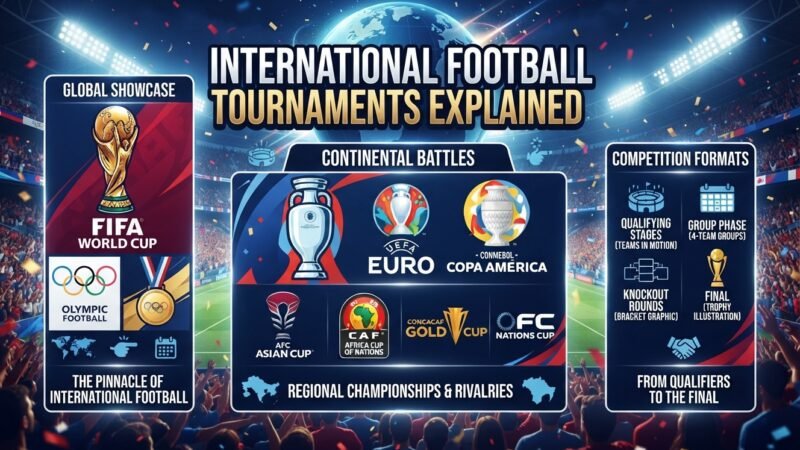
Some tournaments are global, while others are limited to specific continents or regions. The FIFA World Cup is the most widely recognized international competition, while events such as the UEFA European Championship, Copa América, Africa Cup of Nations, AFC Asian Cup, and CONCACAF Gold Cup provide major continental championships.
These tournaments can use group stages, knockout rounds, qualification matches, or combinations of these formats.
FIFA World Cup
The FIFA World Cup is the flagship international football tournament. It brings together national teams from across the world after a qualification process that takes place within different confederations.
The tournament traditionally includes a group stage followed by knockout rounds. Teams compete for points during the group phase, with successful nations advancing to the elimination stage.
Knockout matches create a different type of pressure because one poor performance can end a team’s tournament. Matches that remain level after regulation time may proceed to extra time and, when necessary, a penalty shootout.
The World Cup has produced some of football’s most recognizable players, teams, goals, and historic matches.
UEFA European Championship
The UEFA European Championship, commonly known as the Euros, is the major international tournament for European national teams. It features many of the strongest football nations in Europe.
Qualification determines which teams reach the final tournament, where they compete through group and knockout stages. European football has a deep competitive structure, and the tournament regularly features established national teams alongside emerging sides.
The Euros have also provided important international stages for players who later become major figures in club football.
Copa América
Copa América is the major men’s national-team championship in South America. Organized by CONMEBOL, the competition has a long history and includes some of the continent’s most successful football nations.
South American international football is known for technical ability, passionate supporters, tactical variety, and historic rivalries. Matches between traditional rivals can attract worldwide attention.
The tournament format has changed at different times, including variations in the number of participating teams and competition structure. Its historical importance remains a major part of international football.
Africa Cup of Nations
The Africa Cup of Nations, organized by the Confederation of African Football, is one of the leading international tournaments on the African continent.
The competition features national teams from across Africa and has helped showcase generations of talented players. Many African footballers have used international tournaments as platforms before establishing successful careers in European and other global leagues.
The tournament’s group and knockout stages provide opportunities for both established football nations and developing teams to compete on a major stage.
AFC Asian Cup
The AFC Asian Cup is the premier men’s national-team competition in Asia. It brings together teams representing countries across a geographically and culturally diverse continent.
Asian football has developed considerably over the decades, with national teams from East Asia, West Asia, Southeast Asia, Central Asia, and other regions competing for continental honors.
The tournament offers an important opportunity to measure national-team development and identify emerging players. Tactical approaches can vary significantly between participating nations, making the competition particularly interesting for international football fans.
CONCACAF Gold Cup
The CONCACAF Gold Cup is the major men’s national-team tournament for the North American, Central American, and Caribbean region.
Teams compete through qualification and tournament stages to determine the regional champion. The competition has helped increase the international profile of football across the CONCACAF region.
The United States, Mexico, Canada, Costa Rica, Jamaica, and other national teams have contributed to the tournament’s competitive history. Matches can feature different tactical approaches and playing styles because of the diversity of football cultures within the region.
Regional International Competitions
In addition to major continental championships, international football includes several regional competitions.
Examples include the UEFA Nations League, CONCACAF Nations League, and other regional tournaments designed to provide competitive fixtures for national teams. These competitions can reduce the number of purely friendly matches while giving teams meaningful opportunities to earn results and develop their squads.
Regional tournaments are also useful for younger or developing national teams because regular competitive matches provide valuable experience.
Qualification for International Tournaments
Qualification is an important part of international football. Depending on the tournament, national teams may compete in groups, league-style formats, or regional qualification systems.
Qualification campaigns can last for months or years. Teams need consistent results to secure a place in the final tournament, while goal difference and other tiebreaking criteria may become important when teams finish level on points.
The qualification process also allows smaller football nations to compete against more established teams and potentially create unexpected results.
Group Stage Format
Many major international tournaments begin with a group stage. Teams are divided into groups and play against the other nations in their section.
A standard football scoring system awards three points for a win, one point for a draw, and no points for a defeat. Teams are then ranked according to the competition’s official tiebreaking rules.
The strongest teams advance to the knockout phase, where every match becomes increasingly important. Group-stage performance can determine not only qualification but also the opponents teams face later in the competition.
Knockout Stages and Final Matches
Knockout football is fundamentally different from league competition because there is no opportunity to recover points over a long season. Teams must win or advance through the specified tie-breaking process.
Round-of-16 matches, quarterfinals, semifinals, and finals can create intense pressure. Tactical decisions become particularly important because managers must balance attacking ambition with defensive security.
The final represents the conclusion of the tournament and determines the champion. Winning an international final can become one of the defining achievements of a player’s career.
Importance of International Football
International football tournaments have cultural significance beyond the sport itself. National teams can bring together supporters from different backgrounds and create shared experiences across entire countries.
These competitions also provide a platform for players to represent their national identity and compete against different football cultures. Young players can gain international experience, while established stars have opportunities to create lasting legacies.
For people researching sports-related commercial information, a Sports Betting Agent may appear in connection with football content, but official football organizations and tournament authorities remain the appropriate sources for competition rules, fixtures, results, and qualification information.
How to Follow International Football
Fans can follow international tournaments through official competition websites, national football associations, sports broadcasters, and reputable sports news services. Checking official sources is especially useful for confirming schedules, squad announcements, tournament regulations, and results.
Following the group standings can help fans understand qualification scenarios, while learning the tournament format makes knockout matches easier to analyze.
Conclusion
International football tournaments are a central part of the global football calendar. From the World Cup and European Championship to Copa América, the Africa Cup of Nations, Asian Cup, and Gold Cup, each competition has its own history, structure, rivalries, and football culture.
Understanding qualification systems, group stages, knockout rounds, and tournament rules provides a stronger foundation for following national-team football. As new generations of players emerge and established teams continue to compete for international honors, these tournaments will remain an important source of sporting history and memorable moments.