X-Ray Baggage Scanner: How It Works, Types and How to Choose One
An X-ray baggage scanner uses low-dose X-rays to show the contents of bags and parcels on a screen without opening them. Tunnel size, image quality, single or dual view and operator training decide how well a machine performs. Choose the machine for the biggest item you need to scan and the volume you handle, then check approvals, service and training before you compare prices.
Anyone who has put a bag on a conveyor at an airport, court or metro station has met a baggage scanner. The bag disappears into a tunnel, a screen shows a coloured image and an operator decides in seconds whether it moves on. It looks simple. Behind that simplicity sits a lot of engineering and a good deal of human skill.
This guide explains how an X-ray baggage scanner works, what types of baggage scanner machine exist, how airport scanners differ from the rest and what to check when comparing baggage scanner manufacturers.
What is a baggage scanner?
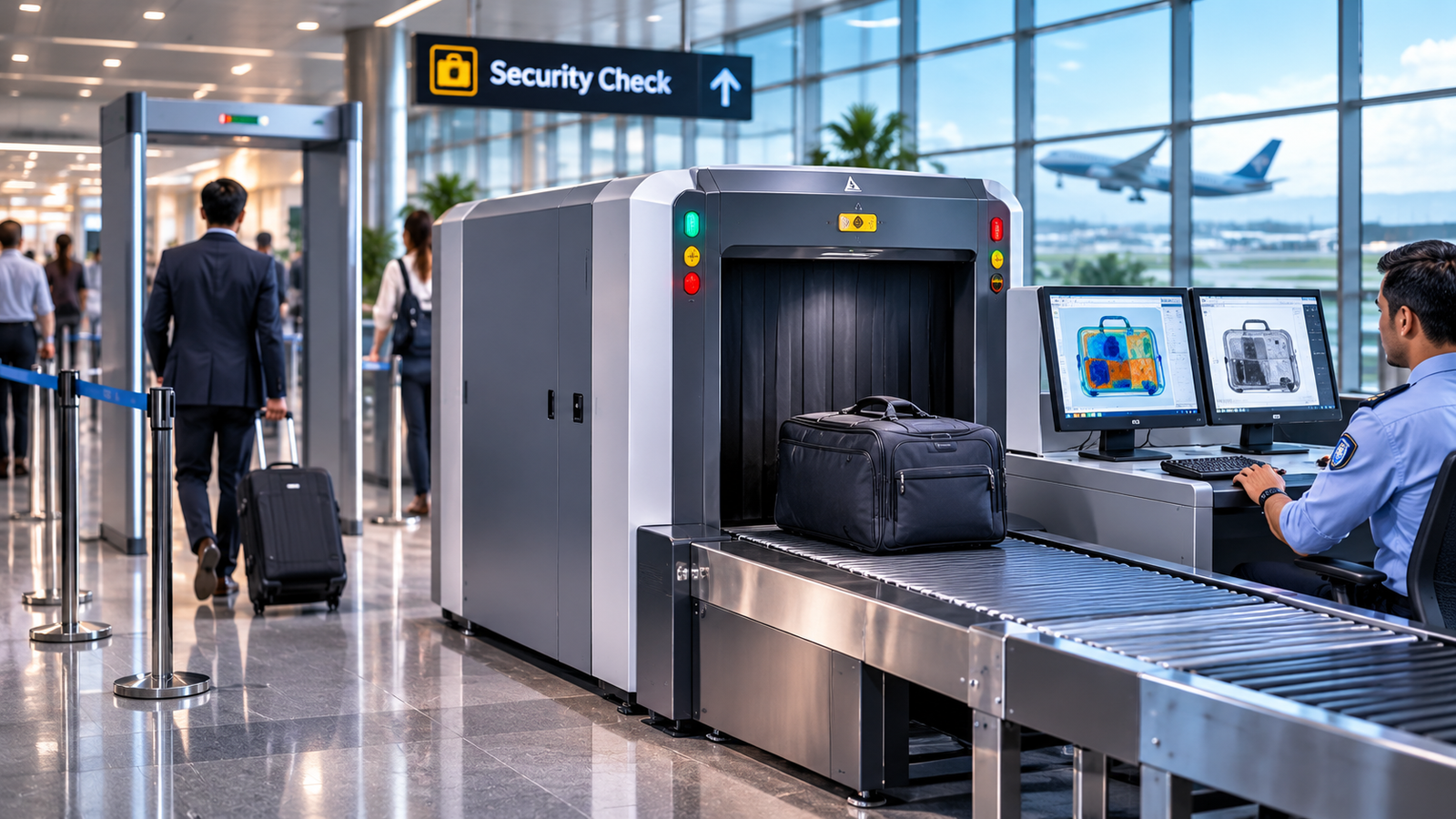
A baggage scanner is a security machine that inspects bags, parcels and cargo without opening them. Most use X-rays, which is why people also search for X-ray scanners or X-ray scanner machines. The item travels on a conveyor through a shielded tunnel, the machine captures an image and the operator reviews it on a monitor.
How an X-ray baggage scanner works
- Loading. The bag is placed on the conveyor belt.
- Scanning. The belt carries it through the tunnel, where an X-ray source sends a narrow beam through it.
- Detection. Detectors on the other side measure how much radiation passes through.
- Imaging. Software turns that data into an image. Dense items absorb more X-rays and look darker.
- Colour coding. Most machines colour organic materials, inorganic materials and metals differently, which helps the operator spot something unusual.
- Decision. The operator clears the bag or sends it for a manual check.
The radiation stays inside the shielded tunnel, and the dose to a bag passing through is low. Even so, radiation safety rules apply to this equipment, which we cover below.
Types of baggage scanner machines
By tunnel size
- Small tunnel: compact machines for handbags, laptops and small parcels. Used in offices, hotels, malls and mailrooms.
- Medium tunnel: the most common size, handling backpacks, suitcases and cartons. Used in metro stations, government buildings, courts and event venues.
- Large tunnel and cargo: built for big boxes, pallets and air cargo. Used at airports, ports and logistics hubs.
By imaging
- Single view: one X-ray angle. Simpler and lower in cost.
- Dual view: two angles, which gives a clearer picture of crowded bags and helps operators decide faster.
By use
- Parcel and mail scanners for courier and postal screening.
- Checkpoint scanners for people entering a building.
- Hold baggage and cargo scanners for items that travel separately from the passenger.
Airport baggage scanner: what is different?
An airport baggage scanner works on the same principle, but the demands are higher. Airports screen very large volumes, deal with a huge variety of bags and operate under strict aviation security rules.
Two kinds of screening exist at most airports. Cabin baggage is checked at the security checkpoint, usually with a medium tunnel machine and an operator watching live. Checked baggage goes through larger systems, often built into the baggage handling line, and uses more advanced detection and review stages.
Because the stakes are high, airport equipment has to meet the approvals set by the aviation security authority. If you are supplying or buying for an airport, confirm the exact requirements with the authority and the supplier before you go further. Equipment that suits a mall or office entrance is not automatically suitable for an airport.
Where else baggage scanners are used
- Metro and railway stations
- Government buildings, courts and police stations
- Malls, hotels and event venues
- Corporate offices and IT parks
- Schools, universities and hospitals
- Stadiums and exhibitions
- Courier, post and cargo hubs
- Prisons and defence sites
How to choose a baggage scanner
1. Start with the biggest item. The tunnel must fit the largest bag or parcel you will scan, with some margin. Buying too small is the most common and most expensive mistake.
2. Estimate volume. How many bags per hour at peak? A machine that is too slow creates queues, and a queue at a checkpoint becomes a security risk of its own.
3. Ask about image quality. Look for clear penetration and fine wire resolution, so small or thin objects are visible. Ask for a live demonstration or sample images, ideally with bags like yours.
4. Consider single or dual view. Dual view helps with dense or crowded bags but costs more.
5. Check the software. Useful features include image zoom, enhancement, threat highlighting, image storage and user login levels.
6. Check load capacity and conveyor speed. Heavy items and fast belts need stronger components.
7. Confirm approvals. Ask which approvals apply to your site and whether the machine meets them.
8. Plan space and power. Measure the floor space, plan the operator position and confirm the power supply before delivery.
9. Plan training. A good machine in untrained hands gives poor results. Operators need training to read images well.
Choosing among baggage scanner manufacturers
Searching for baggage scanner manufacturers brings up a long list. A few checks help narrow it.
| Question | Why it matters |
|---|---|
| Are you the manufacturer, an authorised dealer or a trader? | Decides who handles service, spares and warranty |
| Can I see a live demo or visit an installation? | Image quality is hard to judge from a brochure |
| Which approvals does the machine hold? | Needed for your site type |
| Who installs and trains our operators? | Training affects results as much as hardware |
| How fast is service in my city? | Downtime at a checkpoint is costly |
| What does the warranty cover? | X-ray tube and detectors should be named |
| Which spares are stocked in India? | Long delays can stop the checkpoint |
Only call a vendor a manufacturer if they can prove it with factory details, authorisation letters or a project list.
Safety and regulation
X-ray equipment is subject to radiation safety regulation in India. Ask the supplier which registrations and approvals apply to your machine and your site, and confirm the details with the relevant authority. Also check that the shielding is properly maintained, that operators follow safety procedures and that regular servicing is scheduled. Do not leave this to the end of the project. It can affect delivery and use.
Common mistakes
- Buying a tunnel too small for the largest item
- Judging image quality from a brochure and not a demo
- Ignoring operator training
- Forgetting floor space, power and operator position
- Choosing on price with no local service
- Using a machine at a site type it was not approved for
Pair it with the rest of your security
A baggage scanner works best as one layer. People entering the same checkpoint may also pass through a flap barrier or tripod turnstile, and vehicles at the gate may use a boom barrier.
[Add one real example, for instance: “At a [type of site], the first machine chosen had a tunnel too small for the parcels they receive. Switching to a larger tunnel fixed the problem.” Use only a true story from your team.]
Frequently asked questions
What is an X-ray baggage scanner?
It is a security machine that uses low-dose X-rays to show the contents of bags and parcels on a screen without opening them.
How does a baggage scanner machine work?
A conveyor carries the bag through a shielded tunnel, detectors measure the X-rays that pass through and software builds a colour-coded image for the operator.
What is the difference between an airport baggage scanner and a regular one?
Airport scanners handle higher volumes and must meet aviation security approvals. Machines for malls or offices may not qualify for airport use.
Are X-ray baggage scanners safe?
When properly shielded, maintained and operated, the radiation stays inside the tunnel. Always follow the safety rules and approvals that apply in India.
How do I choose between baggage scanner manufacturers?
Compare image quality in a live demo, approvals, training, service speed and warranty on one checklist, not just price.
Does Houston Systems supply baggage scanners?
[Confirm and add details here.]
Final thoughts
A baggage scanner is only as good as the match between the machine, the site and the people using it. Size it for your largest item, test the image quality, confirm the approvals and train your operators.
If you are comparing options, the team at Houston Systems can help you match a baggage scanner to your site.